Short answer: they are ready for targeted launches, provided the sample matches the intended user and sales claims
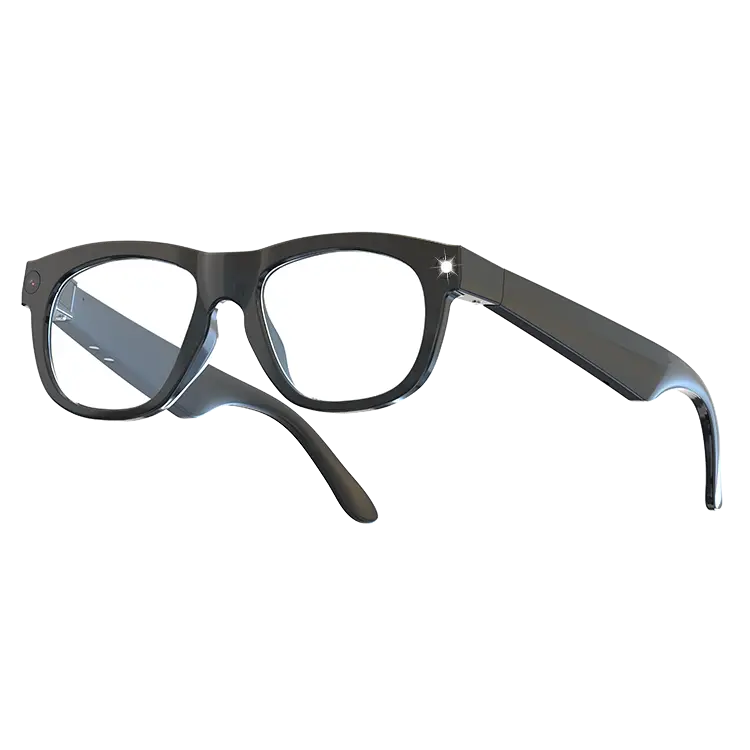
Smart camera glasses are ready for a controlled retail or private-label launch, but not as a universal replacement for a phone, action camera or standalone AI device. The strongest proposition is straightforward: hands-free photo and video capture combined with calls, music, voice assistance and selected app-based AI functions.
Category timing is favorable because relatively few established brands occupy the space. That creates room for a competitively priced product, but it also raises the burden on the buyer. Consumers may not yet understand what the glasses can do, which functions require a phone, or how recording is disclosed. Before placing a bulk order, you need a sample, a defined user scenario and claims that can be demonstrated repeatedly.
Camera hardware, saved media and AI features are three separate buying questions
A wide-angle camera specification doesn’t tell you how usable the finished files will be. Nor does the presence of AI terminology mean that processing takes place inside the glasses. Treat camera performance, local storage and software-assisted functions as separate parts of your evaluation.
Cheung Shing lists a 120-degree fixed-focus camera, 2 GB of built-in storage and app-based DeepSeek access for its smart camera glasses. Those specifications establish the basic architecture, but a production sample must show how the parts work together.
Why a 120-degree fixed-focus camera does not by itself confirm photo or video output quality
A 120-degree field of view can capture more of a scene without requiring the wearer to aim precisely. That suits walking tours, inspections and casual first-person clips. The trade-off may be edge distortion, smaller-looking subjects and less useful detail at a distance.
Fixed focus removes the delay and complexity of autofocus, but close objects may fall outside the sharpest range. Ask for unedited files from the exact sample—not social-media uploads—and inspect exposure changes, stabilization, audio synchronization, compression artifacts and readability of faces or signs. Resolution, frame rate, codec and file format should appear in the approved specification because the viewing angle alone confirms none of them.
Which DeepSeek, object-recognition and translation functions may require the app, a paired phone or internet access
Cheung Shing describes DeepSeek access, object recognition and translation as app-supported capabilities. Buyers should therefore determine which tasks run on the glasses, which run in the mobile app and which depend on an external online service. Test what happens when the phone is locked, cellular service is weak, permissions are denied or the service account is unavailable.
The listed phone support is Android 7 through 14 and iOS 12 or later. That is a useful starting range, not proof that every handset, operating-system skin or future update will behave identically. Your sample plan should include current Android and iPhone models used by the intended customer base.
Match the product to realistic consumer scenarios rather than positioning it as an all-purpose camera
The easiest product to sell is one with a narrow, credible job. Smart glasses can remove the need to hold a phone, yet their small battery, fixed camera position and dependence on a companion device set practical boundaries.
Best-fit uses: hands-free photos, short videos, calls, music and voice assistance
Good use cases include capturing a short first-person clip while walking, taking a quick photo when both hands are occupied, listening to directions, answering a call and invoking voice assistance. Object recognition or translation may add value for travel, retail demonstrations and accessibility-oriented tasks when the app connection is available.
Positioning matters. “Capture a quick hands-free moment” is easier to support than promising professional video or continuous recording. Retail staff also need a simple explanation of what is stored locally and what passes through the paired phone.
Limits to test: low-light capture, recording duration, AI accuracy and unsupported phone environments
Small wearable cameras often face difficult exposure conditions: moving from sunlight into a store, filming under mixed LED lighting or recording at night. Check for motion blur, flicker, blown highlights and delayed exposure correction. Run repeated clips rather than one ideal demonstration.
Measure usable recording time from a full charge under the actual operating mode, then note heat, shutdown behavior and remaining battery. Test AI responses with unclear objects, regional accents and ambiguous text; recognition and translation can be wrong. Also try unsupported or restricted environments, including a phone without mobile data, corporate devices that block app permissions and operating-system versions outside the stated range.
A visible recording indicator and privacy-by-design behavior can influence retailer acceptance
Cheung Shing lists a recording indicator, an important feature for a camera worn at eye level. A buyer should still verify that the indicator remains visible whenever recording is active, can’t be disabled through ordinary settings and behaves correctly after an app crash or low-battery event.
Review microphone and camera permissions, file deletion, account access, cloud processing and any data retained by third-party AI services. Recording and consent rules vary across U.S. states, and retailers may impose policies beyond legal minimums. Packaging and instructions should tell users to respect private property, posted restrictions and local audio-recording laws without implying that the indicator alone resolves consent.
Verify the 220 mAh battery, 2 GB storage, magnetic charging, app compatibility and one-year warranty through a Cheung Shing sample
A sample should be treated as a qualification unit, not a showroom piece. Confirm that the 220 mAh battery reaches an acceptable operating time across recording, calls, music and standby. Fill the 2 GB storage with real files to observe available capacity, file rollover, transfer speed and behavior when memory is full. Check whether the magnetic connector seats consistently and whether replacement cables can be supplied.
Pair the glasses repeatedly with Android and iPhone devices, test touch controls with different users, and confirm that the recording indicator is easy to see without distracting the wearer. For the one-year warranty, define when coverage starts, who pays return freight, which failures qualify and whether replacement parts or complete units are provided.
Cheung Shing operates manufacturing in Huizhou and serves brands through its SINDE brand as well as OEM/ODM cooperation. Its injection-molding capability may support physical customization, but color, logo, tooling and packaging scope should be confirmed in writing. Review the current OEM smart camera glasses information against the sample and approved purchase specification.
Go/no-go checklist: confirm branding scope, packaging, MOQ, sample policy, lead time, quality records and applicable U.S. compliance documents before ordering
- Target user: Name the primary use case and reject claims that the sample can’t reproduce consistently.
- Branding: Confirm SINDE distribution or private-label scope, logo method, frame colors, app branding and any new-mold charges.
- Commercial terms: Obtain written MOQ, sample cost, production lead time, payment terms, spare-unit allowance and warranty procedure.
- Packaging: Approve the included cable, instructions, privacy language, warnings, barcodes and country-of-origin marking.
- Quality control: Request inspection criteria and records covering camera operation, battery charging, storage, touch controls, audio, pairing and recording-indicator function.
- Software: Identify the app publisher, required permissions, update policy, AI-service dependencies and handling of customer data.
- U.S. documentation: Ask which FCC requirements apply to the wireless hardware, obtain applicable battery transport documentation such as the UN 38.3 test summary, and review labeling, chemical and retailer-specific requirements with your compliance adviser.
- Final gate: Compare the approved sample, specification sheet and packaging to a pre-shipment production unit. Proceed only if all three match.