
Are They Really Bone Conduction? A 2026 Buyer’s Guide to Smart Sunglasses Claims
A common smart-glasses listing mistake is treating “open ear,” “Bluetooth” and “bone conduction” as interchangeable terms. They aren’t. Bluetooth describes the wireless connection. Open ear describes a design that leaves the ear canal unobstructed. Neither tells you how sound reaches the cochlea.
That distinction matters in 2026 because many products sold as Bone Conduction Sunglasses actually use small directional speakers positioned near the ears. Those glasses may still work well. The problem is an inaccurate mechanism claim, which can mislead consumers and create trouble for U.S. importers, retailers and private-label brands.
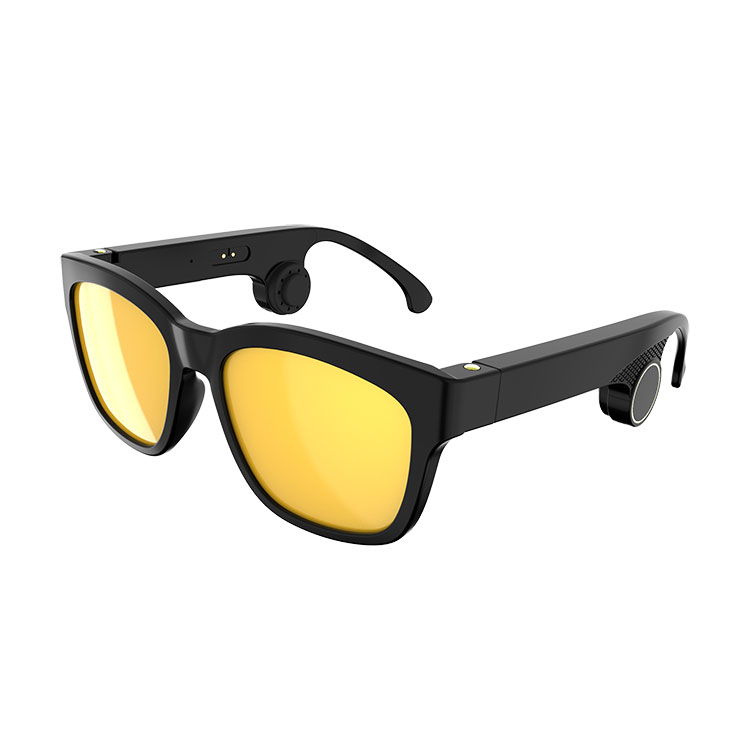
Short answer: Bluetooth and an open-ear design do not prove bone conduction
True bone-conduction glasses use transducers that press against the head and send mechanical vibration through bone and tissue. Speaker-based audio glasses move air through a driver and direct sound toward the ear canal. Both can play music, handle calls and support voice assistants while leaving your ears open.
You can’t settle the question by checking the Bluetooth version, pairing screen or marketing name. Even a frame described as “bone conduction” needs physical or documentary evidence of the transducer arrangement. Some designs are hybrids, using vibration transducers alongside audible speakers, so a simple listening test may not provide a complete answer.
Bone-conduction transducers and near-ear speakers produce different physical evidence
A bone-conduction transducer needs useful contact with the wearer’s temple, cheekbone area or another suitable point on the head. You should therefore expect contact pads or actuator housings designed to maintain pressure despite normal head movement. Weak contact usually causes lower output, inconsistent bass and a greater need to raise the volume.
Near-ear audio glasses tend to have visible sound ports or grilles in the rear portion of the temples, aimed toward the entrance of each ear. Their performance depends more on driver orientation and the distance between the port and ear. Moving the frame slightly up or down may change loudness noticeably.
What buyers can inspect, feel and request without dismantling the glasses
Start with a visual inspection. Find the sound outlets, then look for separate contact surfaces over the temple area. During playback, lightly lift the suspected contact pad away from the skin. A substantial change can support a bone-conduction claim, while sound that remains clearly audible through a nearby port suggests an air-conduction speaker. Felt vibration is useful evidence, but it isn’t conclusive; speaker housings can vibrate too.
For purchasing decisions, request a transducer datasheet, an internal layout or section drawing, the transducer part number and a written explanation of the acoustic path. A credible supplier should be able to distinguish the audio driver from the microphone, Bluetooth module and frame components without hiding behind the phrase “open-ear technology.”
Compare both designs on calls, music, awareness, sound leakage and noisy-environment performance
| Criterion | Bone-conduction design | Near-ear speaker design |
|---|---|---|
| Phone calls | Playback depends on firm transducer contact. Call quality still relies heavily on microphone placement and noise processing. | Speech can sound natural, but nearby people may hear the caller at higher volume. |
| Music | Often favors speech and midrange clarity over deep bass. Strong vibration can become distracting. | Usually has more potential for conventional tonal balance, though fit changes what reaches the ear. |
| Environmental awareness | Leaves the ear canal open. | Also leaves the ear canal open. Open ears don’t guarantee that you’ll notice traffic or warnings. |
| Sound leakage | Not automatically private; transducer housings may radiate audible sound. | Leakage is common when volume is raised or ports sit far from the ear. |
| Noise and wind | Background noise can still mask the signal, and wind can overwhelm the microphone. | Airborne audio competes directly with traffic, machinery, surf and wind. |
For cycling, the frame must also coexist with a helmet and remain stable over rough pavement. For fishing, lens suitability, corrosion exposure and control operation with wet hands may matter more than the acoustic label. Neither design should be treated as hearing protection or as a substitute for situational judgment.
Test production-representative samples under realistic listening and wear conditions
A quiet conference room hides the failures buyers later discover outdoors. Test several units from the intended production configuration, not one polished engineering sample. Use the same firmware, lenses, temple geometry and battery that will ship. Include different head widths because clamping force affects both comfort and bone-conduction coupling.
Run listening checks with spoken audio, music and calls. Walk near traffic at a safe distance, stand in moderate wind and wear the glasses with any helmet, cap or hearing protection expected in normal use. Compare the result with the supplier’s own description rather than assuming one acoustic design must always outperform the other.
Check wind noise, call clarity, leakage, fit, controls, battery claims and unit-to-unit consistency
- Ask the person at the other end of a call to score speech clarity, wind noise and dropouts.
- Check leakage in a quiet room with another person standing nearby.
- Wear each sample long enough to expose temple pressure, slipping and vibration discomfort.
- Operate buttons or touch controls while walking and while wearing light gloves.
- Verify play time under a documented volume level and repeatable call-and-music pattern.
- Compare multiple units for channel balance, rattles, charging behavior and pairing stability.
Cheung Shing’s published SD-G2 details provide a baseline—not proof of the acoustic mechanism
Cheung Shing’s bone-conduction sunglasses page identifies an SD-G2 example with Bluetooth 5.0, a TR90 frame, a stated weight of 43 grams, a 120 mAh battery, approximately six hours of play time and a one-year warranty. The company also states production capacity of 3,000 smart-glasses units per day and describes molding, SMT, testing and assembly resources in Huizhou.
Those details establish useful questions for sampling and commercial review, but none proves the acoustic mechanism. Bluetooth 5.0 is a radio specification. TR90 identifies a frame material. Weight and battery capacity affect wear and runtime, not whether sound travels primarily through vibration or air. Production capacity also needs to be separated from demonstrated yield, consistency and on-time output.
Request mechanism evidence, FCC records, battery transport documentation and any retailer-required safety or material reports
For a U.S. program, match the FCC identifier and model information to the radio configuration that will ship. FCC equipment records address radio compliance; they don’t certify a product as bone conduction. For the lithium battery, request the applicable UN 38.3 test summary and shipping documentation from the responsible supplier. Confirm that reports identify the actual cell, battery and finished configuration rather than a vaguely related model.
Ask for any lens, material, labeling or safety reports required by your retailer or sales channel. Compare names, model numbers and component revisions across every file. Buyers evaluating an OEM bone-conduction sunglasses manufacturer should also define who controls firmware changes, packaging claims and replacement obligations after launch.
Use separate go-or-no-go criteria for personal use and U.S. wholesale programs
A consumer can make a practical decision from fit, intelligibility and intended use. A wholesale buyer carries a wider burden: the product, claims, records and cartons all need to describe the same item.
Consumers should prioritize fit and use conditions; OEM and private-label buyers must also verify documentation, consistency, packaging and warranty terms
- Personal-use go: The glasses fit securely, remain comfortable, deliver understandable calls and provide adequate audio in your actual environment.
- Personal-use no-go: You’re relying on the words “bone conduction” to guarantee privacy, strong bass, hearing protection or safe road use.
- Wholesale go: Production-representative samples pass defined checks, the physical mechanism matches the claim, documents match the shipping model, and packaging avoids unsupported promises.
- Wholesale no-go: The supplier won’t identify the transducer, provides records for a different configuration, can’t explain battery transport status, or shows wide variation among samples.
- Before purchase orders: Put acceptance limits, approved components, inspection rights, change-control requirements and warranty responsibility in writing.
Send Inquiry



X
We use cookies to offer you a better browsing experience, analyze site traffic and personalize content. By using this site, you agree to our use of cookies.
Privacy Policy