
Sports Bluetooth Glasses for Active Use and Custom Programs
A runner reaches for the volume control without breaking stride. A cyclist needs to hear an approaching car. A private-label buyer needs the frame, electronics and packaging to survive more than a polished showroom demo. Those situations expose the difference between ordinary audio eyewear and Sports Bluetooth Glasses designed for active use.
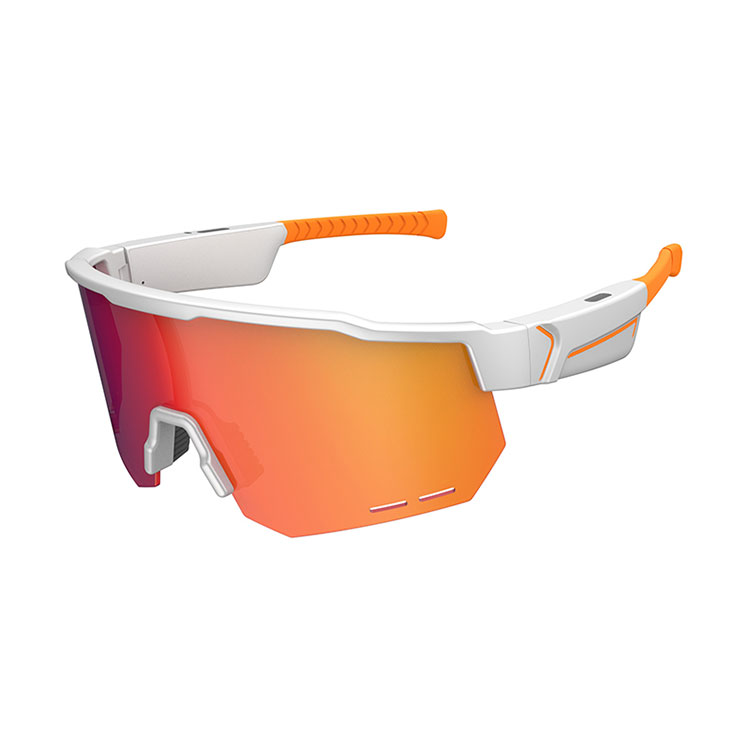
The sports label should mean secure fit, practical lenses and open-ear audio—not merely Bluetooth in a glasses frame
Open-ear speakers leave the ear canal unobstructed. That can help you remain aware of traffic, instructions and other people, but it doesn’t guarantee situational awareness or make the glasses hearing protection. High playback volume can still mask outside sound, while people nearby may hear leakage in quiet settings.
Fit matters just as much as audio. Temple pressure, nose contact, frame width and weight distribution determine whether glasses stay put when the wearer sweats or looks down. A Bluetooth logo says nothing about those details.
Match the glasses to the activity, environment and limits of open-ear listening
Start with the intended activity rather than a feature list. Sports Bluetooth sunglasses used on a quiet trail face different demands from glasses worn beside urban traffic or on a windy boat.
Running and cycling: test stability, controls, awareness, wind noise and sound leakage
For running, test bounce at the nose and temples, not just static comfort. Controls should be easy to locate with damp fingers, and accidental presses shouldn’t interrupt a workout. For cycling, check helmet compatibility and whether the temples create pressure beneath helmet straps.
Wind is a common failure point. Open-ear Bluetooth glasses may reproduce music acceptably at rest yet become difficult to hear at speed. Microphone performance can deteriorate too, making calls unclear to the person on the other end. Test call quality outdoors, facing into and away from the wind. Also check leakage at the volume customers are likely to use—not only at a low demonstration setting.
Fishing, hiking and driving: choose suitable lenses and account for weather, traffic laws and distraction
Fishing and hiking put more emphasis on lens coverage, glare control, UV documentation, sweat exposure and changing weather. If polarized lenses are required, confirm that option in writing and inspect optical distortion rather than assuming every tinted lens is polarized.
Driving raises separate concerns. Local laws and employer policies may restrict device use, and voice controls can still distract the driver. Lens tint must remain suitable for the actual light conditions. These glasses shouldn’t be positioned as safety eyewear unless the exact product has the required testing and documentation for that claim.
Evaluate the features that determine comfort, audio quality and retail suitability
A sample should answer questions that a specification sheet can’t. Use several wearers, include longer sessions and record the configuration tested so later production can be compared with it.
Frame fit and lenses: verify TR90 and PC construction, sizing, coverage, optical quality and any polarized or prescription options
Cheung Shing publishes TR90 and PC as materials for the category. Confirm which parts use each material; a material list alone doesn’t identify the frame, temples or lenses. Ask for overall dimensions, frame width, temple geometry, product weight and available colors for the production revision.
- Inspect the lenses for haze, distortion, inconsistent tint and distracting reflections.
- Check coverage at the sides and below the eyes for the intended activity.
- Ask for evidence supporting UV, polarized or other optical claims used on retail packaging.
- If prescription compatibility matters, determine whether the design accepts inserts, replacement lenses or neither. Don’t assume.
Speakers, microphones and durability: compare call clarity, wind handling, controls, charging, sweat protection and hinge strength
Listen at low and practical outdoor volumes. Compare speech clarity, left-right balance and leakage, then place calls in a quiet room and outside. Confirm how voice assistance is activated and whether it depends on the paired phone.
Charging method, connector access and status indicators affect everyday usability. So do hinge play, button feel and cable strain inside the temples. If sweat or water resistance is part of the sales plan, request the applicable rating and test report for the exact model. No protection level was supplied here, so it shouldn’t be inferred from the word “sports.”
Use Cheung Shing’s published Bluetooth 5.2+EDR, 150mAh battery and one-year warranty as a baseline, then confirm the exact configuration
The company’s open-ear Bluetooth glasses listing states Bluetooth V5.2+EDR, a 150mAh battery and a one-year warranty. It also publishes play time, charging time, wireless range, weight and dimensions on the product page. Because components and configurations can change, place the revision-specific values in the quotation, approved specification sheet and purchase agreement.
Battery capacity by itself doesn’t establish real playback time. Volume, call use, connection conditions and power management all affect results. Ask how runtime was measured and repeat the test on a production-representative sample. For the warranty, clarify the start date, covered failures, exclusions, return process and responsibility for freight.
Connect OEM and ODM claims to evidence: clarify the Cheung Shing–Sinde relationship, factory ownership, tooling, injection molding, SMT, assembly and stated 2,000-piece daily capacity
Cheung Shing presents itself as an OEM/ODM supplier with its own mold workshop, more than 100 injection machines, SMT resources and over 10 assembly lines. It states production capacity of 2,000 sports Bluetooth glasses per day. Those figures are useful for initial screening, but capacity should be tied to your selected configuration, order quantity, component availability and quality plan.
If Cheung Shing and Sinde names appear across websites, quotations, factory documents or product labels, ask for a written explanation of the legal and operating relationship. Identify which entity signs the contract, owns or operates each facility, receives payment, controls tooling and carries warranty responsibility.
For a private-label program, request dated factory photos or a live audit covering mold making, injection molding, SMT and final assembly. Ask which operations are performed in-house and which are subcontracted. Tool ownership, maintenance, storage and end-of-program transfer terms should be written into the agreement—not left to email assumptions.
Request a production-representative sample and written answers on customization, MOQ, lead time, packaging, quality controls, warranty service and applicable FCC, RoHS, UL or other market documentation
A cosmetic sample isn’t enough. Request the electronics, lenses, firmware, battery, charging parts and packaging proposed for production. Then ask for written answers covering:
- Available logo, frame color, lens, firmware, accessory and retail-packaging customization
- MOQ by configuration and any separate minimums for custom parts or printing
- Sample, tooling and production lead times, including approval stages
- Incoming inspection, in-process checks, final inspection and lot traceability
- Warranty handling, spare units, defect reporting and corrective-action procedures
- FCC, RoHS, battery transport, UL-related or other documentation applicable to the exact product and US sales channel
Documentation should identify the tested model and match the product you’ll import. A report for a similar device may not cover a changed radio module, battery, charger or enclosure.
Send your target activity, market, estimated volume, lens requirements, branding files and packaging plan when you request a Sports Bluetooth Glasses sample or quotation from Cheung Shing. That gives the supplier enough information to answer against a defined configuration instead of a generic catalog item.
Send Inquiry



X
We use cookies to offer you a better browsing experience, analyze site traffic and personalize content. By using this site, you agree to our use of cookies.
Privacy Policy