A 20L square pail is often chosen for one practical reason: it uses pallet and warehouse space more efficiently than a round format. That apparent simplicity can hide a difficult purchasing brief. Buyers still need to verify the intended contents, lid arrangement, filling method, label area, handling requirements and export-packing expectations before a supplier can assess the project properly.
Cheung Shing Development (H.K.) Ltd. lists 20L Square Pails within its Injection Moulding catalogue. Headquartered in Hong Kong, with a factory in HuiZhou, China, the company serves customers in China, Europe and the United States. Its listed range also includes round pails in 20L, 18L, 15L, 13L and 10L formats, giving procurement teams a useful starting point when they need to compare footprint, pack-out and application fit.
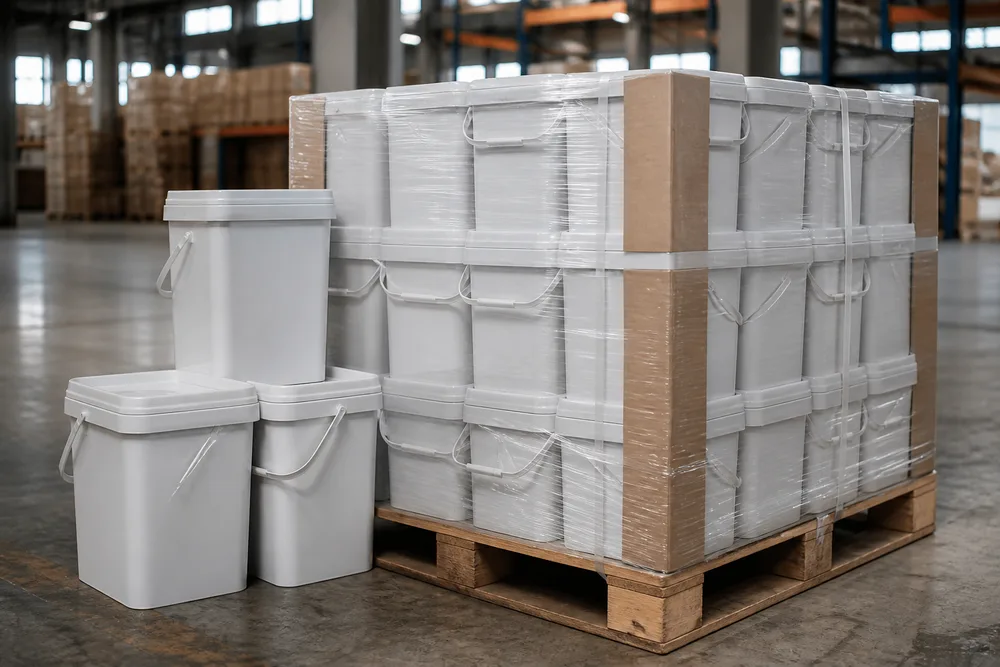
Key Takeaways: Cheung Shing 20L Square Pails for Export and OEM Procurement
- Cheung Shing lists 20L Square Pails as part of its injection moulding product catalogue.
- Critical pail details—including material, dimensions, lid design, handle type and product compatibility—should be confirmed against your application.
- Useful enquiries include artwork, packing configuration, destination market and required compliance documents from the first contact.
- The company states it operates an in-house mould workshop, more than 100 plastic injection machines, CNC equipment and assembly lines in HuiZhou.
For export and OEM procurement, the purchase order should describe the complete pack system rather than the pail alone. A pail that looks correct in a photograph can still be unsuitable if the closure does not match your filling line, the label panel does not accommodate your artwork, or the packing method is wrong for the destination route. Start with the filled product and the way it will be handled—not with colour alone.
Cheung Shing’s Injection Moulding catalogue is the appropriate reference point for identifying the listed 20L square pail and discussing an OEM requirement. Ask for confirmation in writing on every feature that affects use, shipment or regulatory review.
20L Square Pail Specification and Procurement Data: Details Buyers Should Confirm
“20L” identifies the nominal capacity class; it does not answer the questions that cause most downstream trouble. You need the actual overall dimensions, usable filling volume, pail weight, wall construction, rim and lid interface, plus the configuration of any handle. Those points affect stacking, manual handling, label application, truck loading and whether the pail will run reliably through your own filling and closing equipment.
Material compatibility deserves the same attention. State what will be packed, its temperature at filling, expected storage period and any exposure to oils, solvents, moisture or food-contact conditions. Do not assume a general-purpose pail is approved for a particular chemical or regulated end use. Request the relevant declaration or test evidence needed for your market before approving production.
| Procurement item | Why it matters | What to confirm with Cheung Shing |
|---|---|---|
| Capacity and dimensions | Controls filling, stacking and pallet planning. | Nominal and usable capacity, external dimensions and tolerance expectations. |
| Resin and contents compatibility | Determines suitability for the product being packed. | Material identification and application-specific documentation, where required. |
| Closure and handle | Affects sealing, opening and transport handling. | Available lid, rim, tamper-evidence and handle options. |
| Decoration and packing | Changes brand presentation and shipping risk. | Artwork method, label area, carton or pallet configuration and export protection. |
A sample evaluation should mimic real use: fill it, close it with the intended procedure, apply the label, stack it as shipped and inspect it after transit simulation where your quality system requires one. Empty-pail approval alone is not enough.
How to Source Custom 20L Square Pails from Cheung Shing
Good sourcing moves faster when the enquiry arrives as a usable technical brief. The best requests separate confirmed requirements from preferences and open questions. That gives the manufacturer a fair basis for discussing a listed product, possible customisation and any mould-related implications without guessing what “heavy duty” or “standard export quality” is supposed to mean.
Step 1: Define Application, Product Compatibility and Required Pail Features
- Describe the packed product, fill conditions, storage environment and intended market.
- Identify the required capacity class, closure concept, handle needs, colour and decoration requirements.
- Provide physical samples or drawings where an existing pail must be matched, and flag features that cannot change.
- List the documents your customer, regulator or internal quality team will require before release.
Be especially clear about compatibility and transport expectations. A pail intended for dry goods can have a very different brief from one carrying liquid, paste or a product with demanding storage conditions. This is where vague specifications become expensive.
Step 2: Submit Your Enquiry, Artwork, Packaging and Delivery Requirements
Send quantity expectations, delivery destination, preferred shipping terms, artwork files and packaging instructions with the initial enquiry. If labels, printing or other branding are involved, identify the artwork revision and approval owner. State how pails should be packed for receipt: nested, palletised, bagged or otherwise protected as required by your operation.
Use Cheung Shing’s 20L square pail injection moulding page to begin the product discussion, then ask the sales team to confirm the current production and custom options that apply to your order.
Cheung Shing’s HuiZhou Injection Moulding and Mould Workshop Capability
In-house mould workshop is the part of Cheung Shing’s stated manufacturing setup that matters most for a custom plastic pail programme. In practical terms, it places mould-related work alongside the injection moulding operation rather than treating tooling as a separate, remote hand-off. Injection moulding uses a mould tool to form the plastic component; the tool’s cavity surfaces, parting line, gates, cooling arrangement and ejection system all influence the final part’s appearance, dimensional consistency and production behaviour.
Cheung Shing states that its HuiZhou factory has more than 100 plastic injection machines, CNC equipment, assembly lines and an in-house mould workshop. That combination is relevant when your project includes both moulded parts and secondary assembly or packing requirements. It does not replace product validation. Buyers should still define inspection criteria, approve relevant samples and agree how changes to tooling, colour, closure parts or packing will be controlled.
For a pail project, ask who owns approved drawings, how revisions are identified, and what sample stage is required before full production. Those are mundane questions. They prevent the wrong lid, artwork revision or packing configuration from reaching a container.
20L Square Pails FAQ: Samples, Customisation, Export Packing and Compliance Documentation
The questions below should be resolved before a purchase order is released. Requirements vary sharply by contents, destination and customer specification, so a direct written response from the supplier is more useful than a generic packaging claim.
Can Cheung Shing provide samples of 20L Square Pails?
Ask Cheung Shing about sample availability, lead time, sample condition and freight arrangements for the specific 20L square pail configuration you need. Evaluate samples with the intended contents, closure process and label rather than approving only the visual appearance.
Can a 20L square pail be customised for an OEM programme?
Discuss required colour, branding, closure details, handle configuration, packing and any dimensional or functional requirement directly with Cheung Shing. Custom work may affect tooling, approval timing and minimum order expectations, so provide drawings, reference samples and artwork early.
What export packing should buyers specify?
Tell the supplier the destination, transport method, warehouse handling conditions and how the pails will be received. Confirm nesting, pallet arrangement, protective materials, outer wrapping and shipping marks in the agreed packing specification. A square footprint helps space planning, but it does not remove the need to validate load stability.
What compliance documentation is available?
Document needs depend on the pail material, intended contents and destination regulations. Send your required standard, declaration format or customer checklist to Cheung Shing and request confirmation of what documentation can be supplied for the proposed product before production approval.
Request a Quote for 20L Square Pails from Cheung Shing
A quote request should identify the 20L Square Pails product, application, destination, expected order quantity, preferred delivery timing and any required custom features. Attach artwork, reference photographs or a drawing where they exist. Include your packing expectation and the compliance documents your market requires; these details can change the manufacturing and shipment discussion materially.
If you are comparing a square pail against a round alternative, send the same use case to the supplier for both options. Cheung Shing lists both formats in its plastic pail range, and a like-for-like review of footprint, closure, handling and pack-out is more useful than choosing by appearance. Visit the official Injection Moulding product page and submit a concise technical brief for confirmation.
Start Your 20L Square Pail Enquiry
Share your application, quantity, destination, artwork and packing requirements with Cheung Shing to discuss the listed 20L Square Pails product and applicable OEM options.
Visit Official Website →