A 25-litre pail looks simple until it arrives at a filling line, sits in a warm warehouse, or reaches a distributor with a cracked lid. The purchase decision is not just about capacity. It is about the relationship between the pail body, lid, filling product, handling method and destination-market requirements. Cheung Shing supplies customizable 25L round PP pails for packaging programs that need a practical injection-moulded container and manufacturer-led OEM support.
Polypropylene is widely selected for pails because it is lightweight, mouldable and suited to many food, liquid, fruit and chemical-packaging uses, subject to the actual product and regulatory requirements. That qualifier matters. A pail suitable for one product is not automatically suitable for another, especially where chemical compatibility, hot filling, transport conditions or food-contact rules are involved.
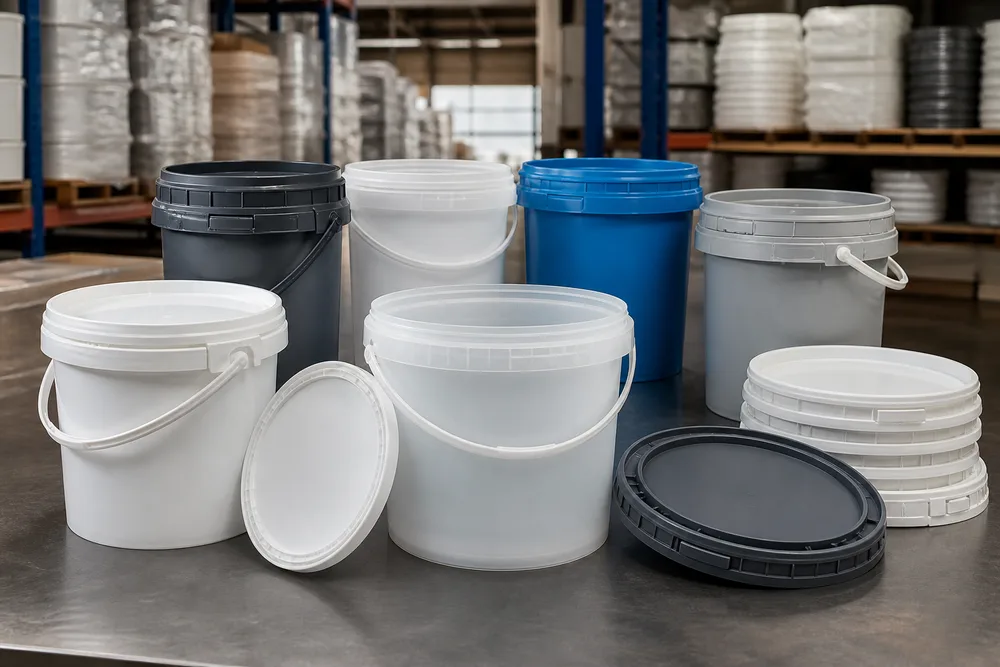
Key Takeaways for Sourcing 25L Round Pails from Cheung Shing
- Confirm the lid and closure arrangement against your filling, transport and opening requirements.
- Match PP material selection to the packed product, food-contact obligations and intended market.
- Discuss wall thickness, stackability and handling conditions before approving a sample.
- Use Cheung Shing’s mould-design and OEM/ODM support where a standard pail does not fit the job.
Cheung Shing Development (H.K.) Ltd. has operated since 1993 and manufactures from HuiZhou, serving customers in China, Europe and the United States. For procurement teams, that background is relevant because the supplier is not merely sourcing finished buckets: it develops plastic injection moulds and injection-moulded products.
The central production capability is automatic injection lines: automated production equipment that repeatedly injects molten PP into a controlled mould cavity, then cools and ejects the formed pail. In practical terms, this process supports repeatable geometry, consistent rim formation and scalable output. It does not remove the need for approval testing. You still need to establish the closure fit, leak performance and handling behaviour using your own product and logistics conditions.
25L Round Pail Specifications and Configuration Options to Confirm
Start with the pail as a system, not a catalogue photograph. The nominal 25L capacity must be reviewed alongside usable fill level and the headspace your product needs. Foaming products, viscous materials and products with temperature-driven expansion may require more headspace than a dry granular product. Ask how capacity is defined and evaluate it with the selected lid in place.
Cheung Shing describes its PP pails as customizable, with added thickness, stackability and various lids available. Those options should be written into the quotation request rather than left as assumptions. A thicker wall can improve resistance to handling damage, but it affects material use, weight and cost. Stackability may be important for warehouse efficiency, yet stacked pails must be assessed with the actual load, pallet pattern and storage duration in mind.
| Parameter | What to confirm | Why it affects procurement |
|---|---|---|
| Material | PP grade and suitability for the packed product | Food contact and chemical compatibility are application-specific. |
| Lid configuration | Lid type, fit, opening method and any required seal | The closure governs leak risk and user access. |
| Wall and rim design | Required thickness and sealing-rim performance | These features influence impact resistance and lid engagement. |
| Stacking | Filled-stack conditions and pallet arrangement | A pail can perform well alone and still deform under a loaded stack. |
Colour, branding, mould changes and packing format also belong in the discussion. Review the available 25L pail configuration options before you freeze artwork or fill-line tooling.
How to Select a 25L Pail for Food, Liquid, Fruit or Chemical Packaging
Food and fruit buyers often focus first on food-grade material. That is necessary, but not enough. You should identify the product, contact conditions, destination market and any documentation your compliance team requires. Fresh fruit may create a very different packaging brief from sauces, oils or other liquid foods. Moisture, product acidity, filling temperature, cleaning process and the length of storage can all change what must be verified.
For liquids, closure performance is usually the first field failure point. A lid that feels secure by hand may behave differently after vibration, pressure changes or repeated handling. Specify the intended filling process and assess the pail-lid combination with the actual product where possible. Cheung Shing identifies its pails as leak-proof, but buyers should define the test conditions and acceptance criteria for their particular programme rather than rely on a general label.
Chemical packaging demands the most caution. “Chemical” covers materials with radically different behaviour, and PP suitability depends on the formulation, concentration, storage time and temperature. Provide the supplier with the relevant product information and have your technical or regulatory team confirm compatibility. Do not approve a container solely because it worked for another chemical. The same disciplined approach applies to handles, if required, because lift points and grip requirements depend on how filled pails move through your operation.
Cheung Shing’s Injection-Molded Pail Manufacturing and Customization Process
Injection moulding is a sensible route for a round pail where repeatable shape, a defined rim and production consistency matter. Cheung Shing’s experience spans mould development and injection-moulded products, which gives OEM buyers one accountable route from concept discussion through mould design and production. A custom tool is a serious commitment, though. It should follow a stable packaging brief, not precede one.
- Define the pack: share the product type, fill conditions, target market, lid requirement, handling method and expected order pattern.
- Review the configuration: agree the PP pail body, thickness expectation, stacking need, closure format and branding or mould requirements.
- Approve samples: check fit, appearance and performance with representative product, filling and distribution conditions.
- Release production: confirm packing, inspection expectations and delivery details before the production order proceeds.
The mistake is requesting “a stronger bucket” without describing the failure you need to prevent. Is the issue sidewall denting, lid seepage, rim distortion, pallet compression or a problem with the filler? Each points to a different design or process question. Give Cheung Shing that context early; it is the difference between a meaningful OEM discussion and an expensive cycle of sample revisions.
25L Round Pail FAQ: Lids, Leak Testing, Food Contact, MOQ and Export Orders
Which lids are available for 25L round pails?
Cheung Shing states that various lid options are available. The correct choice depends on filling method, product viscosity, resealing needs, opening experience and leakage risk. Ask for the lid-body pairing to be evaluated as one closure system, not as two independent parts.
Are Cheung Shing 25L pails leak-proof?
The company describes the pails as leak-proof. Your purchase specification should still state the liquid, fill level, orientation, storage and transport conditions used for validation. A general leak-proof claim is not a substitute for application-specific testing, particularly for liquids or chemicals.
Can these PP pails be used for food contact?
Cheung Shing identifies food-grade material for this category. Confirm the applicable food-contact requirements for your market and product, then request the documentation and sample evaluation needed by your compliance process. Food suitability is not a universal certification statement; it depends on the intended use.
What is the MOQ for a custom 25L pail?
No fixed MOQ is stated in the supplied category information. MOQ can vary with standard versus custom configurations, colour, lid selection, mould work, packing and order economics. Send a defined brief to obtain a usable answer rather than a nominal quantity that excludes key options.
Can Cheung Shing support export and OEM orders?
Yes. The company states that it serves China, Europe and the United States and provides mould design, customization, OEM and ODM-related production support. Confirm destination, packing requirements, labelling and shipping terms during the quotation stage.
Request a 25L Round Pail Quote, Sample or Custom OEM Solution: https://www.cs-dv.com/contact.html
A quote request gets better quickly when it contains the information production teams actually need: the product to be packed, intended market, whether the pail is for food, fruit, liquid or chemical use, preferred lid arrangement, colour or branding requirement, estimated purchasing volume and delivery destination. If you have an existing pail, include photos of the rim, lid and any damage you are trying to eliminate. Those details expose issues that a generic capacity request misses.
For a custom OEM project, explain what cannot change and what can. Capacity may be fixed, while colour, wall design or label area may be open to discussion. For a standard procurement programme, ask for a sample and assess it on your own line before committing to the full order. Contact Cheung Shing through its stated enquiry channel, then compare the proposed solution against your filling, handling and compliance checklist.
Start your 25L pail enquiry with the right brief
Share your packed product, closure need, destination market, custom requirements and expected order volume to discuss a suitable PP pail solution with Cheung Shing.
Visit Official Website →