Choose a China injection moulding manufacturer by proving five things before you compare unit prices: the factory can handle your part and resin, controls the moulding tool, has production resources that suit the application, can show how it verifies quality, and receives enough information to quote the job correctly. A low piece price means little if the tool changes hands without records, sample approval is vague, or the supplier has not seen the mating parts that determine fit.
For a custom plastic part, the supplier is not simply making components. They are managing a chain of decisions from mould design through injection moulding, inspection, packing and, where needed, assembly. That chain deserves more scrutiny than a price spreadsheet.
Start With the Manufacturing Scope Your Plastic Part Requires
First, define the work you actually need done. Some projects need only an existing mould run. Others require mould development, sampling, production, secondary operations, assembly and retail-ready packaging. Treating those as the same enquiry is a common source of bad comparisons between China plastic injection moulding suppliers.
Start with the part’s function rather than its appearance. A cosmetic package may need consistent surface finish and closure fit. A plastic pail may depend on lid engagement, wall stiffness and stacking behaviour. A phone case can be judged on camera and button openings, but the real issue is often the fit against the device it encloses. Consumer-electronics housings can bring assembly interfaces, cable clearances and visible cosmetic surfaces into the same part.
Can the supplier develop the mould, mould the part and support assembly?
Ask for a clear boundary between tooling, moulding and downstream work. If the supplier is responsible for the mould, establish who reviews the part design, who records tool modifications, and what happens after sample feedback. If assembly is required, identify the components supplied by you, the components sourced by the factory, the assembly sequence and the acceptance standard for the finished item.
Cheung Shing Development (H.K.) Ltd. describes its offer as plastic injection moulds and injection moulding services, with plastic packaging and plastic products alongside OEM, ODM and custom-design services. Its listed product categories include CD/DVD cases, cosmetic, candy and food packaging cases, storage cases, phone case moulds and plastic pails. That breadth is useful if your project crosses moulding and product finishing, but it does not remove the need to document the exact scope for your own part.
Assess Tooling Control Before Comparing Piece Prices
Tooling control is where an apparently cheap injection moulding quote can become expensive. The mould determines repeatability, cycle stability, maintenance needs and how quickly a production issue can be corrected. Buyers often focus on cavity count or tool price, then discover too late that they have not agreed on trial samples, engineering changes, preventive maintenance or ownership.
Ask whether mould work is performed in-house or managed through another party. Neither arrangement is automatically wrong. The meaningful question is who is accountable for the tool, how changes are approved, and how quickly the people running the mould can work with the people who built or repaired it.
Questions to ask about in-house mould workshops, CNC work, tool changes and ownership
- Is there an in-house mould workshop, and which tooling activities are performed there?
- What CNC capability is available for mould work, repair or modification?
- How are engineering changes requested, approved and recorded?
- Who owns the mould after payment, and where will it be stored?
- What maintenance records can you receive during production?
- What sample approval is required before the tool moves into regular production?
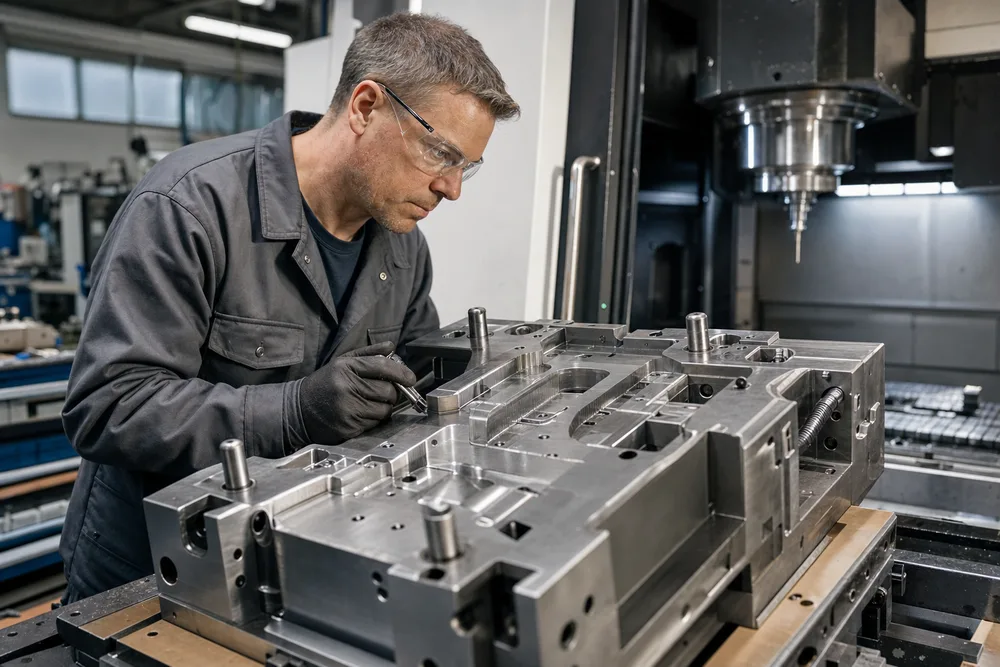
Cheung Shing states that it has an in-house mould workshop and CNC machines at its Huizhou factory. That is relevant evidence to examine in a supplier discussion, especially for programmes likely to need tool adjustments. Ask to tie those resources to your process: the revision path, approval contact, sample identification and maintenance responsibility should be written down, not assumed.
Match Production Resources to Your Product Application
Machine quantity alone is not a production plan. The correct injection machine depends on the mould and part: its shot requirement, mould dimensions, clamping needs, gate design, material behaviour and expected cycle. A factory can have many presses yet still need to confirm that a suitable machine is available for your tool and production window.
Look beyond the press. For packaging, a clean handling route and packing controls may matter as much as output. For housings or wearable-device components, dimensional consistency at interfaces and assembly handling deserve early attention. A supplier should be able to discuss the application-specific risks rather than replying with a generic machine list.
What Cheung Shing’s injection machines, mould workshop and assembly lines support
Cheung Shing reports more than 100 plastic injection machines, an in-house mould workshop, CNC machines, assembly lines and a dust-free workshop. These resources indicate a factory set-up that spans mould manufacture, plastic injection moulding and assembly-related work. The company also lists consumer products including wearable devices, smart glasses, wireless headphones, fast chargers and small home appliances.
Use that information as a starting point, not a blanket guarantee. For your programme, ask which machine type will run the mould, whether assembly is part of the proposed scope, and how parts will move between moulding, inspection, assembly and packing. See Cheung Shing’s injection moulding and mould services in the context of your own part requirements, rather than selecting a factory from a product list alone.
Make Quality Verification Visible From Sampling Through Packing
Quality evidence should be visible at each hand-off. A polished sample on a desk is not proof that a production run will meet the same requirement. You need an agreed sample standard, inspection points that relate to the drawing and function, and a defined method for isolating nonconforming parts.
How 2D and 3D measurement, fit checks and agreed inspection requirements reduce uncertainty
2D and 3D coordinate measuring equipment can provide dimensional evidence where the feature, datum and tolerance have been agreed. They do not decide what matters for you. That comes from the part drawing, critical dimensions, cosmetic acceptance criteria and functional checks.
Build fit checks into the approval plan where parts mate with lids, devices, inserts or assembled components. A nominally in-tolerance part can still fail if the wrong datum is used or if a mating component was not available during sampling. Define the reference parts, the inspection frequency appropriate to the job, the defect examples that require rejection, and the packing condition that prevents scuffing, distortion or mixed lots.
Cheung Shing lists both 2D and 3D coordinate measuring machines, as well as a dust-free workshop. Ask what measurement report can be supplied for your critical features and whether your product’s handling or packing needs justify controlled workshop conditions. Do not claim a quality level that has not been specified and verified.
Provide the Information Needed for a Reliable Injection Moulding Quote
A quote is only as sound as the input package. Send the latest 2D drawing and 3D model where available, the intended resin or approved alternatives, colour and finish requirements, expected annual and order quantities, target markets, packing format, required assembly work and requested delivery timing. Identify critical dimensions, cosmetic surfaces, mating parts and any known failure from earlier tooling.
State what you want quoted separately. Tooling, sample rounds, production parts, assembly, packaging and freight preparation can all change the commercial picture. If you need custom injection moulding in China for a pail, a device case or consumer packaging, include the lid, insert or device sample that determines the fit. Omitting it may produce a fast quote and a slow correction cycle later.
Clear quote inputs also improve communication. The supplier can flag ambiguous wall transitions, difficult surfaces, mould release concerns or inspection gaps before production begins. That is more valuable than receiving a confident price based on guesses.
China Injection Moulding Supplier Shortlist Checklist
- Does the supplier’s stated scope match your need for tooling, moulding, packaging and assembly?
- Can it explain tool ownership, modification approval, maintenance and sample sign-off?
- Has it matched a production machine and process route to your actual part, not just offered capacity in general?
- Can it show how critical dimensions, cosmetic requirements, fit and packing will be checked?
- Have you supplied drawings, resin requirements, quantities, mating parts and acceptance criteria needed for a meaningful quote?
- Can the factory identify limits or open questions before it commits to cost and timing?
If the answers are documented and comparable across your shortlist, you can judge a China injection moulding manufacturer on evidence rather than sales language. For a project discussion grounded in the stated factory resources and product scope, review Cheung Shing Development’s moulding services with your drawings and requirements in hand.