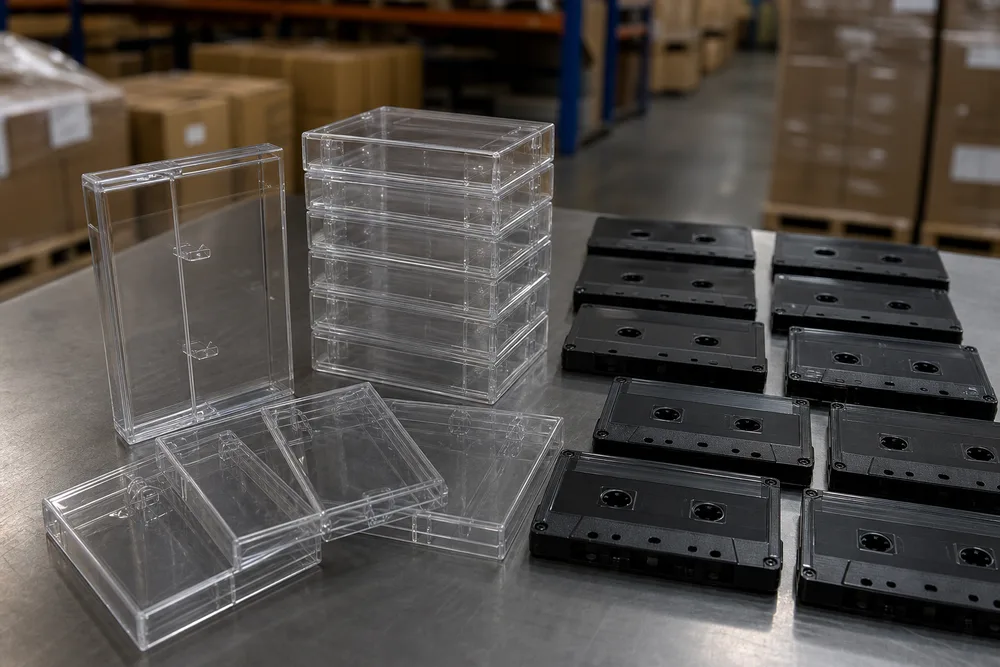
Key Takeaways for Sourcing Empty Cassette Cases in the United States
- Confirm that you are buying an empty cassette case, not prerecorded or blank cassette tapes.
- Check the case’s internal fit, hinge action, closure, and paper-insert arrangement with physical samples.
- Cheung Shing lists a PS cassette tape case, CS-CTC-010, at 109 × 69 × 17 mm and 29 g.
- For branded or nonstandard packaging, discuss private-mold options before committing to volume.
Most cassette-case buying mistakes start with a loose product description. A buyer searches for “cassette tape and cassette case,” but one supplier is quoting empty plastic cases while another is quoting loaded audio cassettes. Those are entirely different purchases, with different freight, assembly, artwork, and quality-control questions.
For U.S. importers, labels, music distributors, duplication houses, retailers, and promotional-product teams, the practical purchase is usually an empty cassette packaging case. Cheung Shing Development (H.K.) Ltd. manufactures injection-molded packaging from Hong Kong, with factory production in Huizhou, China, and lists cassette cases among its packaging products. Its listed cassette cases ship to the United States, Canada, Japan, and Europe.
Cheung Shing also offers private-mold availability: a custom injection-mold development route in which the buyer’s desired case geometry is translated into a dedicated production tool rather than relying only on an existing case design. That route can address a special insert layout, altered exterior profile, or proprietary packaging format. It also demands more homework. Tooling approval, parting lines, hinge design, material behavior, and sample sign-off need to be settled before production begins.
Cassette Tape vs. Cassette Case: What U.S. Buyers Are Actually Ordering
A cassette tape is the audio medium: its shell contains magnetic tape wound around hubs. A cassette case is the rigid protective package that holds that tape for retail display, shipping, storage, or resale. An empty case normally does not include a tape, J-card artwork, printed sleeve, shrink wrap, or assembly service unless a supplier explicitly puts those items on the quotation.
This distinction matters most for buyers building a finished retail pack. A tape duplicator may supply the recorded cassette. Your printer may produce J-cards. The case manufacturer supplies the plastic package. Someone still needs to pack the tape, fold or insert the artwork, check the closure, and manage final labeling. If those steps are being performed by different vendors, ask who owns fit approval. A J-card that looks correct on a flat proof can buckle at the spine or interfere with the case latch after folding.
For a standard empty-packaging inquiry, use direct language such as empty cassette tape cases from Cheung Shing. Include the number of cases required, destination, preferred packaging configuration, and whether you are matching an existing retail case. That prevents the supplier from guessing what “cassette tape case” means in your order.
| Order item | What it is | Buyer check before approval |
|---|---|---|
| Cassette tape | The audio cassette itself | Shell format, duplication status, labels, and recording requirements |
| Empty cassette case | Plastic protective packaging for a cassette | Tape fit, hinge movement, latch engagement, insert compatibility, and cosmetic condition |
| Finished cassette package | Tape assembled into a case with printed components | Which supplier performs printing, assembly, packing, inspection, and labeling |
Cassette Case Specifications and Compatibility Checks Before You Buy
Dimensions are the first screen, not the final answer. Cheung Shing’s product page identifies its PS cassette tape case as model CS-CTC-010, with exterior dimensions of 109 × 69 × 17 mm and a stated weight of 29 g. Those details help a buyer compare profiles and estimate how the case will sit in cartons or retail fixtures. They do not by themselves prove that a particular cassette shell, label thickness, or folded insert will work.
Ask for internal-fit confirmation using your actual tape if possible. Cassette shells can vary subtly, especially with specialty runs, thicker labels, unusual hub windows, or older stock. The tape should seat without force, remain supported when the case is handled, and release without bending the shell or scraping labels. Open and close the sample repeatedly. A hinge that survives one desk test can still whiten, bind, or develop poor alignment if the molding and assembly are not controlled well.
Material also affects the buying decision. Cheung Shing describes CS-CTC-010 as a PS case. If your job has a particular transparency target, color requirement, recycled-content request, or impact-resistance expectation, state it in writing rather than assuming every clear plastic cassette case behaves the same. The same goes for inserts. Supply a folded production dummy, not just an artwork PDF, because paper stock and fold accuracy affect how the pack closes.
Buyers often overlook carton packing and protection between cases. Clear cases can show scuffs quickly, particularly under retail lighting. Ask how cases are packed for transit, how scratches or broken hinges are inspected, and how lot consistency will be judged. Those questions are less glamorous than a custom logo, but they are usually where a low unit price stops being low.
How to Request Samples, Confirm Fit, and Place a Bulk Cassette Case Order
Do not approve a cassette packaging case from a website photo alone. A photo cannot show latch force, hinge feel, internal retention, or how your printed insert behaves after it has been folded and packed. Cheung Shing states a daily output of 10,000 pieces for the listed CS-CTC-010 case, but your order plan should still account for sample approval, transit, production scheduling, and inbound freight to the United States.
A good request gives the manufacturer enough information to quote the right item without turning the first email into a guessing exercise. If the existing case is close but not right, send photos of the open and closed package, identify the feature that must change, and explain what cannot change. “Make it stronger” is not a usable manufacturing instruction. “The front latch must remain compatible with our current folded insert” is.
- Identify the pack: State that you need empty cassette cases and describe the cassette shell and insert you intend to use.
- Request a sample: Test the actual cassette, printed dummy, closure, hinge, and visual appearance under normal handling.
- Approve the reference: Keep a signed or clearly documented approved sample as the benchmark for future inspection.
- Confirm commercial details: Ask for order quantity, packaging method, lead time, shipping terms, and destination requirements in the quotation.
- Review custom-tooling needs: If an existing case will not work, discuss a private mold before finalizing artwork or a launch date.
For an existing format, start with Cheung Shing’s cassette case product information and reference CS-CTC-010 in your inquiry. That gives both sides a common starting point.
Cassette Tape and Cassette Case FAQ for U.S. Buyers
Bulk buyers usually need answers that are more specific than “does it fit?” The useful question is what is included, what physical reference has been tested, and who is responsible if assembled retail components do not work together. Empty cases, tapes, J-cards, printing, and final packing may all be sourced separately. Put each item on the purchase order as its own line item, along with the approved sample or written acceptance criteria.
If you are importing into the United States, also make sure your freight and receiving teams know whether they will receive loose empty cases, master cartons of assembled packs, or multiple components from different sources. A warehouse can receive the correct carton count and still discover an expensive problem later: no inserts, mismatched tapes, or cases that were never tested with the finished printed package. The two questions below should be settled before you release a bulk order.
Do Cheung Shing cassette cases include cassette tapes?
No. Based on the supplied product description, Cheung Shing’s offering is a cassette packaging case, not an audio cassette tape. Treat the case as an empty plastic packaging component unless your quotation specifically lists tapes, printed inserts, assembly, or other items. If you need a finished cassette product, identify which supplier will provide each component and who will perform final packing.
How can I verify that an empty cassette case will fit my cassette tape?
Request a physical case sample and test it with the exact cassette shell, labels, and folded insert planned for sale. Check that the cassette seats securely, lifts out cleanly, does not rub against the closure, and remains protected when the case is closed. Test several open-close cycles and inspect the hinge and latch. For a custom shell or unusual artwork thickness, provide the manufacturer with a representative production sample before approval.
Request a Cassette Case Quote or Product Information from Cheung Shing
Send Cheung Shing a short, complete inquiry rather than a one-line request for a “cassette tape and cassette case price.” Identify the case as empty, cite CS-CTC-010 if that listed format is relevant, state the quantity you are considering, and name the U.S. delivery destination. Tell them if you need samples first and whether your order will use a standard cassette shell, a special insert, or branded packaging.
If you are considering a custom case, include photos or drawings of the intended package and call out the functional features that matter: tape retention, hinge style, latch position, insert space, color, surface appearance, and any logo treatment. Do not release tape duplication or printed J-cards until the physical case has passed a fit test. That one discipline prevents a surprising number of delayed launches and unusable printed components.
Ask About Cassette Case Availability
Review Cheung Shing’s listed cassette packaging case and contact the manufacturer with your volume, sample, fit, and custom-mold requirements.
Visit Official Website →