
Are 13L Round Pails the Right Size for Your Storage Needs?
Most buyers default to 5-gallon buckets. It is an expensive habit. When you fill a 5-gallon container with dense sauces, adhesives, or industrial chemicals, the weight quickly pushes past safe manual lifting limits. Workers struggle. Spills happen on the floor. On the other end of the scale, stepping down to 2-gallon containers means your filling line runs twice as long to package the exact same volume. You need a middle ground.
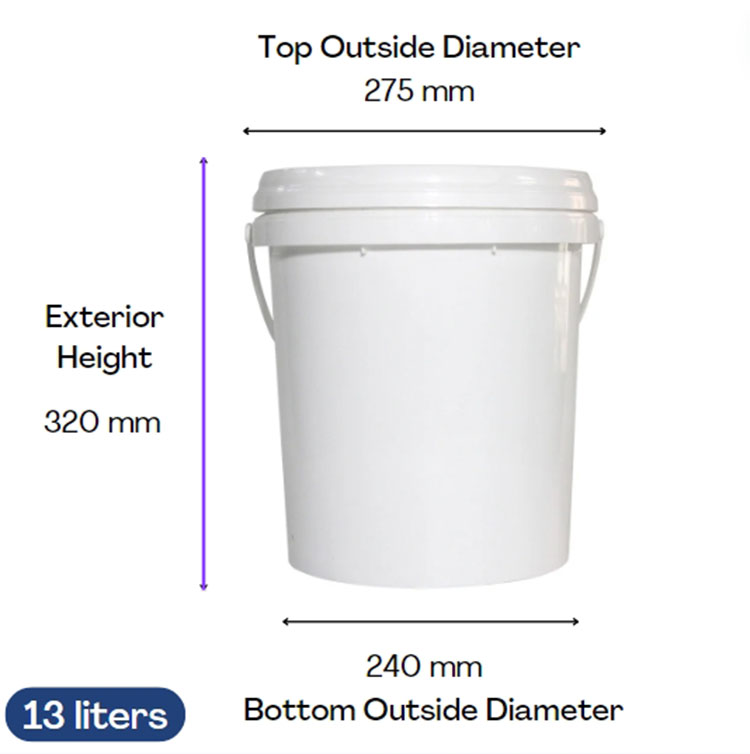
The Operational Advantage of a 3.4-Gallon Mid-Size Container
The short answer is yes: 13L round pails are the right size if your product's bulk density makes a standard 5-gallon bucket too heavy for a single worker to safely lift, or if your commercial buyers demand smaller, fresher batch sizes.
At exactly 13 liters (roughly 3.4 gallons), these containers solve a specific physics problem on the warehouse floor. Water weighs 1 kilogram per liter. Fill a 13L pail with water-based liquids, and it weighs about 28.6 pounds. Fill it with a high-density commercial adhesive, and it might hit 40 pounds. That keeps the unit well under the 50-pound lifting threshold recommended by occupational safety guidelines. A 5-gallon bucket of that same adhesive would weigh over 60 pounds, requiring two-person lifts or mechanical assistance.
Weight Calculation Formula:
Total Weight = (Volume in Liters × Product Density) + Tare Weight of Pail

Example for Commercial Adhesive (Density: 1.2 kg/L):
(13L × 1.2 kg/L) = 15.6 kg (34.3 lbs)
34.3 lbs + 1.5 lbs (Pail) = 35.8 lbs Total Lift Weight
Evaluating the 13-Liter Capacity for Daily Operations
Finding the right packaging means matching the container volume to the end user's daily consumption rate. A bucket that sits open for weeks degrades the product inside.
Ideal Use Cases in Food Processing and Chemical Storage
Food processors and chemical manufacturers buy 13L pails because they fit specific usage windows. Commercial kitchens opening a pail of specialty syrup, marinade, or dry baking powder want to use the entire container before it oxidizes or absorbs ambient moisture. A 13-liter volume matches the weekly usage rate for many mid-sized restaurants perfectly, keeping ingredients fresh without forcing the kitchen to store dozens of tiny jars.
For chemicals, the priority shifts to safe handling and containment. Janitorial suppliers, agricultural chemical blenders, and pool supply companies use this size for concentrated powders and hazardous liquids. The smaller footprint reduces the risk of catastrophic spills during pouring. Rigid injection-molded walls resist puncturing far better than thin-walled bulk bladders or flexible pouches.
Volume and Weight Constraints to Consider
This size is not universally perfect. You should avoid 13-liter containers if you ship high-volume, low-margin commodity liquids. If your end-user goes through 100 gallons of product a week, breaking that down into dozens of 13-liter buckets wastes your packaging budget and pallet space. You need IBC totes or 55-gallon drums instead.
Similarly, low-density dry goods make poor candidates. If you package puffed snacks, dried herbs, or lightweight powders, a 13-liter bucket will hit its volume limit long before it reaches a sensible shipping weight. You end up paying freight rates to ship empty air.
Specification Requirements for US-Bound Plastic Containers
Sourcing packaging from overseas requires strict attention to compliance. A bucket that fails at the port or breaks in the warehouse costs far more than the pennies saved on the initial unit price.
FDA Material Safety and 2026 US Sustainability Compliance
Food-grade packaging must start with virgin resins. Recycled plastics carry the risk of chemical migration, meaning any 13L plastic pails intended for food contact must be injection-molded from 100% virgin High-Density Polyethylene (HDPE) or Polypropylene (PP).
Looking ahead, US state-level Extended Producer Responsibility (EPR) laws taking effect around 2026 demand clear recyclability. Containers must avoid multi-material bonding that complicates sorting at recycling facilities. Single-polymer construction—where the pail, lid, and handle are easily separated or made from the exact same base plastic—will become a hard requirement for US buyers who want to avoid packaging penalties.
Leak-Proof Lid Compatibility and Pallet Stacking Limits
A pail is only as good as its lid. For liquids, you need a gasketed tear-strip lid that provides a verifiable tamper-evident seal and survives the pressure changes of transit.
Stacking strength dictates your freight efficiency. Standard US pallets measure 48 by 40 inches. To maximize shipping density without risking a collapse, the pails must feature reinforced top rims and tapered walls. Cheung Shing engineers these pails in their HuiZhou facility using heavy-duty plastic injection techniques, ensuring the bottom pail can support the static load of three or four fully filled pails stacked directly above it during a hot summer transit.
A Procurement Checklist for Bulk Shipping and Factory Validation
Finding a supplier who can deliver consistent quality at scale requires looking past the sales brochure and into the factory floor. Before placing a bulk order for US distribution, verify these manufacturing realities.
Use this checklist to evaluate your factory partner:
- Tooling lifespan: Ask about the mold warranty. Cheung Shing provides a 2,000,000-cycle warranty on molds, guaranteeing dimensional stability from the first batch to the last. Worn molds create weak spots and leaking lids.
- Production capacity: Verify machine counts. A facility with over 100 plastic injection machines can absorb seasonal demand spikes without subcontracting your order to unvetted secondary shops.
- In-house mold workshops: Factories that maintain their own molds can fix flashing or tolerance issues in hours, not weeks.
- Material certifications: Demand documentation proving the resin is food-grade and free of heavy metals.
- Facility scale: A 40,000-square-meter facility indicates a serious, established operation capable of handling international logistics and large-scale staging.
When you need reliable, stackable, and leak-proof packaging, sourcing directly from a proven manufacturer removes the guesswork. Review the specifications for factory-direct 13L round pails to see if this 3.4-gallon format aligns with your production line.
Send Inquiry



X
We use cookies to offer you a better browsing experience, analyze site traffic and personalize content. By using this site, you agree to our use of cookies.
Privacy Policy