
What Should You Check Before Buying 15L Round Pails in Bulk?
Before you buy 15L Round Pails in bulk, confirm the complete package—not just the capacity on the label. Your written specification should cover usable volume, dimensions, resin, wall thickness, lid fit, handle, testing, customization, order terms, and delivery. A pail that looks suitable in a product photo can still fail because the lid does not match the filling line, the resin is wrong for the contents, or the loaded pallets do not fit your warehouse process.
Cheung Shing Development has produced plastic molds and injection-molded products since 1993. Its HuiZhou factory serves customers in China, Europe, the United States, and more than 40 countries. You can review the company’s 15L round pails as a starting point, then qualify the exact pail-and-lid system for your application.
Start With a Written Specification Instead of Relying on the 15L Capacity Label
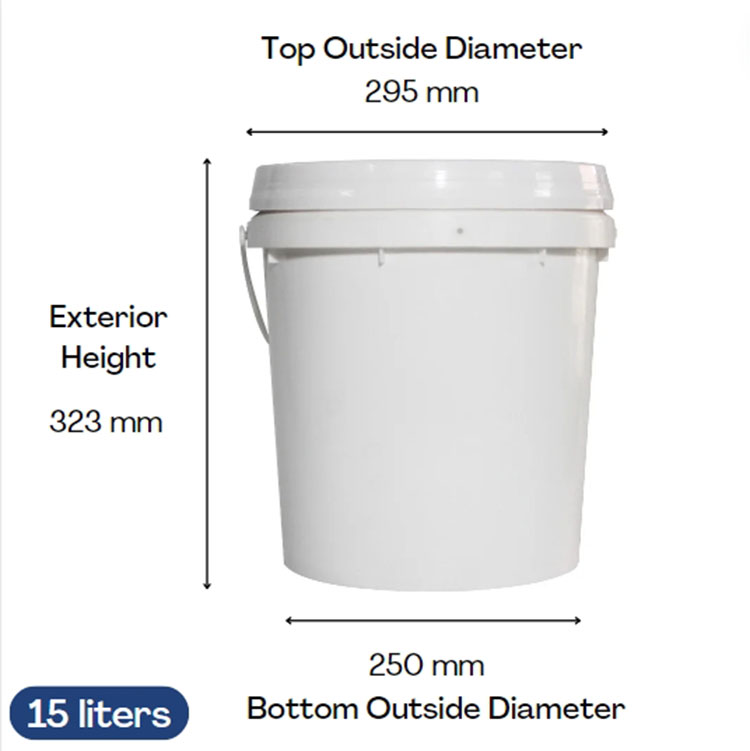
A “15L” pail identifies a nominal capacity, not every dimension that affects production, storage, or filling. Ask the supplier to confirm the following details on a drawing or specification sheet before you compare quotations.
Confirm external and internal dimensions, usable capacity, fill line, empty weight, wall thickness and tolerances
External diameter and height determine carton design, pallet quantity, warehouse racking, and shipping cost. Internal dimensions affect whether your filling nozzle, mixer, scoop, or liner will fit. Usable capacity may be lower than the container’s nominal volume once you allow for headspace, foaming, expansion, or a required fill line.
Request the empty weight, wall-thickness range, key dimensional tolerances, base design, rim geometry, and stacking height. These details matter in different ways. A light pail may reduce material cost but provide less stiffness during automated filling or transport. A thicker wall can improve handling, yet it may increase resin use and freight weight. Do not approve a sample until its measured dimensions and weight match the agreed specification.
Define the resin, lid and closure style, handle configuration, color and decoration requirements
“Plastic” is not a sufficient material specification. Identify the intended resin grade and whether the pail is for dry goods, water-based liquids, viscous products, food, or chemical contents. Specify the lid type, seal or gasket requirement, tamper-evident feature if needed, opening method, and the force your operators can reasonably apply.
Also document handle material and shape, attachment points, color, surface finish, label area, printing, and acceptable color variation. A lid that is easy to remove at the filling line may be too easy to open in distribution. A tight closure may protect the contents but slow packing. That trade-off should be tested, not left to a general phrase such as “leak-proof bucket.”
Treat Food-Grade, Leak-Proof and Chemical-Suitable as Claims That Require Evidence
These descriptions are useful only when they are tied to your contents, closure, process, and market requirements. Ask what evidence supports each claim and what conditions the evidence covers.
Document the resin grade and applicable U.S. FDA food-contact basis for the intended contents and conditions of use
For food packaging sold in the United States, request the specific resin identification, supplier documentation, and the applicable U.S. FDA food-contact basis for the intended food type, temperature, contact time, and use conditions. “Food-grade material” by itself does not prove that every resin, colorant, additive, or lid component is suitable for your product.
Confirm that the documentation covers the entire contact system, including the pail, lid, gasket, handle if relevant, and any masterbatch or decoration that could contact the contents. Keep the approved material record with your quality documents. Cheung Shing’s product information states that food-grade materials are available, but the exact resin grade and compliance basis should be confirmed for your order rather than assumed.
Verify chemical compatibility and leak performance with the actual formula, closure and filling process
A pail can hold water and still be unsuitable for an oil, solvent, detergent, acidic product, or concentrated chemical. Compatibility depends on the resin, concentration, temperature, exposure time, headspace, and stress placed on the container. Ask the supplier to review the actual formula and recommend testing conditions; do not rely on a generic compatibility chart alone.
Leak testing should use the production lid, closure method, fill level, and a representative batch of pails. Test after handling or transport simulation when those conditions are part of your distribution route. Check the base, sidewall, rim, lid seal, and handle attachment. If the pails will carry regulated or hazardous contents, involve your compliance team and confirm the packaging requirements that apply to the product.
Approve the Complete Pail-and-Lid System Through Samples and Application-Specific Testing
Approve the assembled system, not an empty pail by itself. Request production-intent samples with the proposed resin, color, lid, handle, and decoration. Fill them with the real product or a safe substitute that reproduces its relevant behavior, then check closure fit, dispensing, stacking, carrying, drop resistance, leakage, label adhesion, and storage appearance.
Pay close attention to the first and last stages of your process. Can the filling equipment position the pail consistently? Does the lid seat correctly at the line speed you expect? Can warehouse staff open and reseal it without damaging the rim? If the product is heavy or viscous, inspect the handle and sidewall after repeated lifting. Record sample results, test conditions, and acceptance limits before mass production begins.
Use Cheung Shing’s In-House Mould and Injection Capabilities for Controlled Customization
Custom 15L plastic pails make sense when an existing design does not meet your filling equipment, branding, stacking, closure, or material needs. They make less sense when the only goal is a minor cosmetic change that could be handled with a label.
Cheung Shing combines plastic mold design, an in-house mold workshop, CNC and measuring equipment, more than 100 plastic injection machines, automatic assembly lines, and OEM/ODM production. That setup can support a conversation about a new mold or a controlled modification, but it does not remove the need for a written design review. Ask which features require new tooling, how mold ownership is handled, what inspection points will be measured, and how design changes affect MOQ, timing, and unit cost.
For a first comparison, review the company’s 15L plastic pails with lids and identify the features you need changed. A clear reference sample usually produces a better quotation than a broad request for a “custom bucket.”
Settle MOQ, Lead Time, Shipping Terms and Palletization Before Comparing Landed Cost
The lowest unit price is not necessarily the lowest delivered cost. Confirm whether the quotation includes the pail, lid, handle, decoration, tooling, testing, packaging, and export preparation. Ask for the minimum order quantity by color and configuration, the sample timeline, the production lead time after approval, and the reorder process.
Shipping details deserve equal attention. Confirm units per carton, cartons per pallet, pallet dimensions, gross weight, stacking limits, and whether the shipment is floor-loaded or palletized. Agree on the Incoterm, destination, payment terms, and responsibility for freight, insurance, duties, and import clearance. A container plan that ignores pallet height or warehouse handling can erase a small factory-price advantage.
Send contents, annual volume, destination, required tests, artwork and target delivery date for a qualification-ready quotation
Give the supplier enough information to price the real requirement:
- Product contents, viscosity or concentration, temperature, and intended use.
- Required usable fill volume, fill line, closure style, handle, color, and decoration.
- Annual volume, initial order quantity, color split, destination ZIP code, and delivery date.
- Food-contact documentation, chemical-compatibility review, leak testing, or other required approvals.
- Artwork files, label dimensions, pallet preferences, and any warehouse or filling-equipment limits.
Cheung Shing’s 15L Round Pails can be a useful starting point for this qualification process. The right buying decision comes after the supplier confirms the specification, provides representative samples, and shows that the finished pail-and-lid system performs with your contents and handling conditions.
Send Inquiry



X
We use cookies to offer you a better browsing experience, analyze site traffic and personalize content. By using this site, you agree to our use of cookies.
Privacy Policy