
Why Choose Injection Molded 10L Round Pails for Bulk Packaging?
Buyers sourcing 10L bulk containers face a strict trade-off. You can pay a premium for metal, accept the variable wall thickness of blow-molded plastics, or specify injection-molded polypropylene. If you are shipping dense liquids, caustic chemicals, or bulk food ingredients, injection molding is usually the correct choice. It delivers absolute dimensional stability. You get predictable tare weights, exact lid-to-rim interference fits, and vertical crush resistance that blow molding simply cannot match.
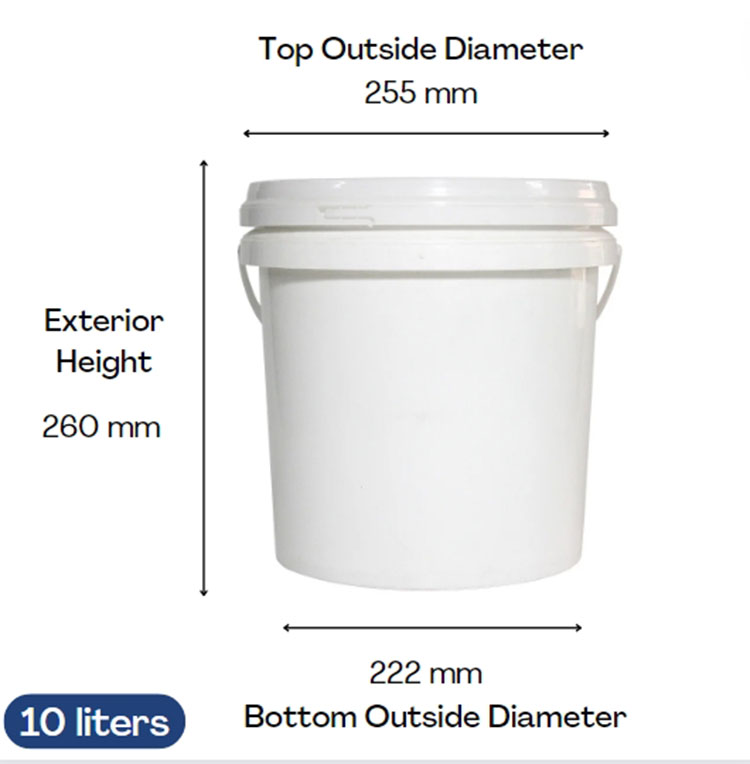
The Structural Superiority of Injection-Molded Pails Over Blow-Molded and Metal Containers
Blow molding pushes air into a heated plastic parison, stretching it to fit a cavity. By the laws of physics, the plastic thins out at the corners and the base radius. That is exactly where a pail takes the most abuse during palletizing, transit, and handling.
Metal pails offer high puncture resistance, but they carry their own penalties. They dent, they rust, they require costly internal linings for chemical compatibility, and they complicate food-contact compliance.
Plastic injection moulding takes a different approach. The process forces molten polymer into a closed steel mold under massive pressure. The resulting 10L round pail has identical, engineered wall thickness from the rim down to the base. When you stack these pails four pallets high in a humid warehouse, that uniform wall thickness prevents the bottom tier from buckling. The weight transfers vertically through the reinforced rim and sidewalls, eliminating the localized weak points common to blown plastics.
Engineering Leak-Proof Lids and Stackable Walls Through Precise Injection Control
A 10-liter container holding water weighs over 22 pounds. If a forklift stops hard on a loading dock, the hydraulic shock inside the pail will pop a weak lid. We prevent this failure mode by designing the mold tooling with micro-millimeter tolerances at the rim and lid interface.
Cheung Shing uses high-tonnage presses to achieve the extra thickness required for heavy-duty stackability. By controlling the cooling rate across the mold, we prevent the microscopic warpage that ruins lid seals. The result is a genuinely leak-proof closure. You rarely need secondary rubber gaskets for most applications; the mechanical interference fit between the lid and the pail rim does the work.
Adapting Food-Grade PP and Recycled Resins for 2026 Sustainability Mandates
Sourcing packaging for the US market now requires navigating Extended Producer Responsibility (EPR) regulations coming into effect across multiple states by 2026. If you are packaging food, you need 100% virgin food-grade polypropylene to meet FDA requirements.
For industrial chemicals, adhesives, or agricultural products, buyers can specify a percentage of Post-Consumer Recycled (PCR) resin. Dialing in the right mix of virgin and recycled material requires precise temperature and pressure adjustments during injection to prevent the plastic from becoming brittle. We manage this directly at the press, ensuring your 10L round pails meet both state sustainability mandates and rigorous drop-test standards.
Material and Compliance Requirements for Food, Chemical, and Agricultural Supply Chains
Not all 10-liter buckets belong in the same environment. The most common mistake buyers make is specifying a generic container without detailing the end-use conditions to their manufacturer.
Food processors require FDA-compliant, BPA-free resins that will not leach off-tastes into cooking oils, syrups, or dry ingredients. Chemical manufacturers need high-density, impact-modified PP that resists stress cracking when exposed to aggressive solvents, paints, or harsh detergents. Agricultural users leave these pails outdoors for months, requiring heavy UV-inhibitor packages blended directly into the resin before molding.
A pail designed for dry pet food will shatter if you use it to ship industrial coatings in freezing temperatures. Specify the environment, and the injection process can be tailored to survive it.
Mitigating Overseas Sourcing Risk With In-House Tooling and a 2-Million-Cycle Warranty
Buying empty volume from overseas introduces freight calculations, but the bigger hidden cost is tooling degradation. If a factory uses cheap P20 steel for their molds, the tool will start wearing out after 300,000 shots. The primary symptom is "flashing"—thin webs of excess plastic leaking at the seams. Flashing interferes with the lid seal. Suddenly, you have a container that leaks on the truck.
Cheung Shing eliminates this by building and maintaining the molds in-house. Our 40,000-square-meter facility in HuiZhou houses both the tooling shop and over 100 injection machines. We back our production molds with a 2-million-cycle mold warranty. If the tool wears out, we rebuild it at our own expense. This guarantees that pail number 1,500,000 fits its lid exactly like pail number one.
Establishing a Reliable OEM Partnership for US-Bound Packaging Procurement
Transitioning to a new packaging supplier requires proof of scale and consistency. Since 1993, Cheung Shing has supplied custom and standard injection-molded components to B2B clients across 40 countries, including high-volume buyers in the United States and Europe.
You need containers that arrive in spec, stack without failing, and seal without leaking. If you are evaluating a switch from blow-molded or metal containers, or simply need to de-risk your current plastic injection supply chain, review the specifications of our injection molded 10L round pails. Direct OEM manufacturing gives you absolute control over the resin, the tooling precision, and the final landed cost.
Send Inquiry



X
We use cookies to offer you a better browsing experience, analyze site traffic and personalize content. By using this site, you agree to our use of cookies.
Privacy Policy