20L Round Pails give bulk-packaging buyers a practical middle ground: a substantial pack size, selectable lids, and a shape designed for stacking. They can suit food, fruit, liquids, and chemical products, but the pail alone does not determine whether a pack will work. Your product, closure, filling process, distribution conditions, and handling routine all need to be checked together.
That is the point buyers sometimes miss. A 20-liter plastic bucket may look like a simple commodity until a lid seeps during transit, a product reacts poorly with the resin, or stacked packs distort under the actual warehouse load. The right configuration is the one matched to the job—not merely the one that holds the required volume.
A 20L Round Pail Combines Bulk Capacity, Lid Options, and Stackable Handling
For products sold, stored, or processed in larger quantities, a 20L round pail can reduce the number of individual units compared with smaller containers. Fewer packs may mean fewer lid applications, fewer labels, and fewer containers to move through receiving and storage. The operational gain depends on your fill volume and workflow, so it should be reviewed against the package size your customers can safely lift and use.
Cheung Shing lists lid choices and a stackable design for its 20L pail range. Those features matter because the lid is part of the package system, while stackability affects the warehouse footprint and how the pails behave in a palletized load. Round plastic pails are also a familiar format for scooping, dispensing, and re-closing in many bulk applications.
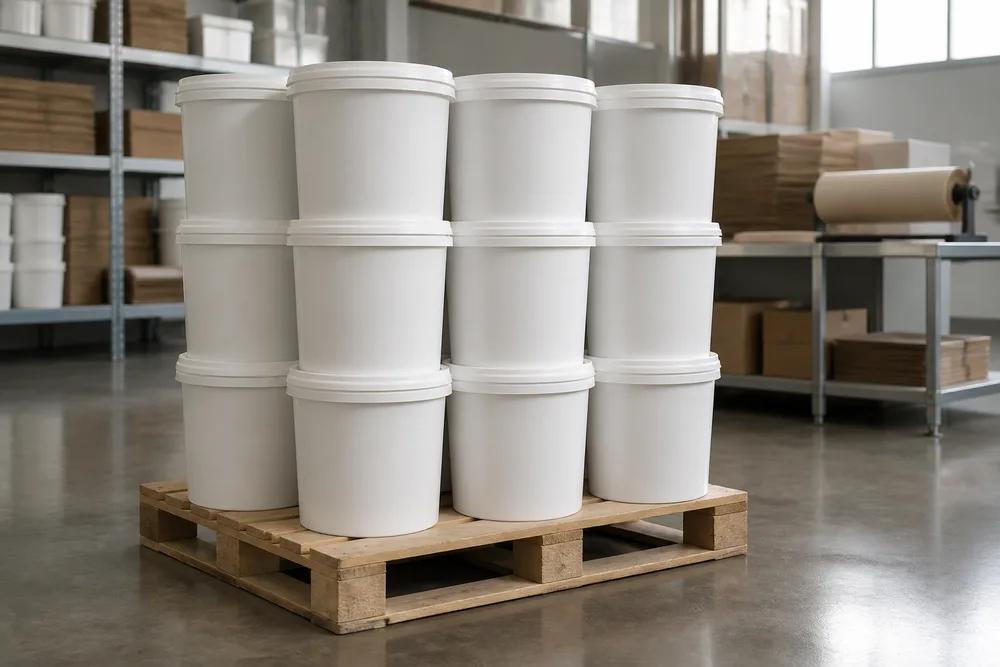
Do not assume every round container uses the same closure fit or stacking performance. A pail body, lid style, fill level, product weight, and storage arrangement work as one system. Confirm the exact combination you intend to buy.
Match the Pail Configuration to What You Need to Pack
A 20L pail is not automatically a food pail, liquid pail, or chemical pail just because it is offered for those broad uses. Start with the product itself: its ingredients, temperature at filling, viscosity, density, expected shelf life, and cleaning or handling conditions. Then identify the closure and any customization the operation requires.
Food, Fruit, and Ingredient Packaging Needs Product-Specific Food-Contact Confirmation
Cheung Shing identifies food-grade materials for its 20L round pails and lists fruit and food applications. That is useful starting information, not a substitute for product-specific approval. Ask which material is proposed for your order and request the food-contact documentation needed for the market where your packaged product will be sold.
This step becomes more important with oily, acidic, salty, hot-filled, or long-held contents. The relevant question is not simply, “Is this pail food grade?” It is whether the selected material and intended use are appropriate for your particular food, contact conditions, and destination-market requirements. If your process needs a tamper-evident feature, a particular opening method, or repeated re-closing, raise that before the mold or lid configuration is finalized.
Liquid and Chemical Applications Require Compatibility and Closure Verification
Cheung Shing also names liquids and chemicals among the potential applications for its pails. Compatibility cannot be assumed from that category description. Chemical concentration, solvent content, temperature, and storage duration can change how a product interacts with a plastic container and closure.
Provide the product description or safety data to the supplier where appropriate. Ask for an assessment of the proposed pail material and lid arrangement, then validate the final pack under your own filling, transport, and storage conditions. A low-viscosity liquid may expose a closure issue that a thick paste never reveals. For regulated dangerous goods, determine separately whether your shipment requires a specific approved package; no such approval is stated here.
How Lid Choice, Added Thickness, and Stacking Affect Daily Operations
Cheung Shing offers lid choices and optional added thickness. Both can affect routine performance, but neither should be chosen by appearance alone.
- Lid selection: Confirm the closure style, fit, opening method, reclosure need, and how it will be applied on your line. A lid that is workable by hand may not behave the same way in a production process.
- Added thickness: More material may be worth discussing where your operation involves demanding handling or stacking conditions. It also changes material use and may affect cost, so specify the problem you are trying to solve rather than requesting “thicker” without a use case.
- Stacking: Verify how filled pails will be stacked, palletized, stored, and transported. Load duration, product weight, temperature swings, and whether pails are nested or separated all matter.
Buyers often focus on the container wall and overlook the lid. In actual distribution, a poorly matched closure can create more trouble than the pail body: drips, contaminated carton surfaces, rejected pallets, and cleanup at the receiving dock. Treat leak-proof integrity as a verified requirement for your specific product and closure, not a label applied after the purchase order.
What to Verify Before Relying on Food-Grade Materials or Leak-Proof Integrity
Cheung Shing states that its pails use food-grade materials and provide leak-proof integrity. Before relying on either claim for a production order, turn it into a written confirmation tied to the exact pail, lid, material, and intended use.
| Check | Why it changes the decision |
|---|---|
| Product and fill conditions | Material suitability may depend on what is packed, the fill temperature, and contact duration. |
| Exact lid and pail pairing | Leak performance depends on the actual closure system, not the pail body alone. |
| Food-contact documentation | Food packaging may need evidence suited to your product and destination market. |
| Stacking and transit plan | Warehouse and shipping loads should reflect real handling, not an empty-pail inspection. |
| Sample evaluation | Filling and handling samples can reveal issues before a larger order is committed. |
Custom 20L Plastic Pails Supported by Mold and Injection Manufacturing
Cheung Shing Development (H.K.) Ltd. and its HuiZhou factory produce plastic injection molds and plastic injection products. That manufacturing background supports custom design and OEM/ODM discussions for buyers who need more than an off-the-shelf bucket.
Customization is most useful when it solves a defined packaging problem: a particular lid arrangement, branding requirement, handling preference, or a pail design that needs to fit an established packing process. It is less useful when the requirement is still vague. Custom tooling and design work need a clear brief, and a change made late in development can affect timing, samples, and purchasing decisions.
If a tailored format is part of your plan, review the available custom 20L plastic pail options with the product, closure, artwork, and operating conditions already documented.
Send Cheung Shing the Details Needed to Assess Your 20L Pail Requirement
Give Cheung Shing a useful starting package: what you are filling; food, liquid, fruit, ingredient, or chemical use; target market; fill conditions; lid preference; stacking and transport plan; and any need for added thickness or custom design. Include the points that have caused packaging failures in the past. Those details are more valuable than a generic request for a 20-liter bucket.
Review the 20L round pail product page, then send the application details needed to assess the right pail-and-lid configuration for your supply chain.