
What Are the Benefits of 18L Round Pails for Product Packaging?
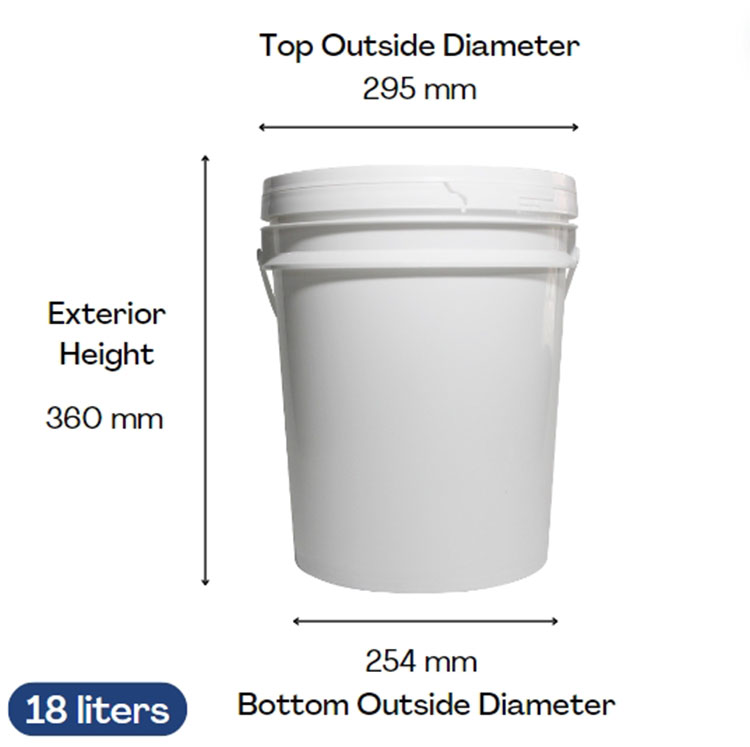
An 18L round pail gives you a practical middle ground: enough capacity for bulk-packed products without creating a container that is unnecessarily awkward to fill, stack, carry, or dispense from. Its real value is not the nominal volume alone. A well-chosen pail combines a suitable resin, wall design, lid system, and decoration method for the product moving through your operation.
For U.S. buyers, the useful question is not simply, “Can this pail hold 18 liters?” It is: can it hold your product through filling, warehousing, transportation, opening, and end use without leaking, cracking, distorting, or creating a compliance problem? Cheung Shing describes its 18L round pails as leak-proof, food-grade-material options with added thickness, multiple lid choices, and customization support. Those are meaningful starting points, but they still need to be matched to the actual application.
An 18L Round Pail Balances Bulk Capacity, Handling, and Brand Flexibility
An 18-liter round plastic pail is often a sensible format for products sold in larger household, foodservice, commercial, or light-industrial quantities. Compared with smaller tubs, it reduces the number of units a filler must handle and label. Compared with a much larger drum, it remains easier for a person to lift, reposition, and pour from under controlled conditions.
The round profile matters. Circular sidewalls distribute pressure around the container instead of concentrating it at corners. That can be helpful with dense or semi-liquid products, and it also gives molders a straightforward shape to produce consistently by injection molding. A round pail generally nests efficiently when empty and presents a familiar handling form for users.
There is a trade-off. Round pails do not use pallet footprint as efficiently as square or rectangular containers, particularly where every inch of truck or warehouse space matters. A buyer moving high volumes should compare loaded pallet patterns, stack stability, and freight economics rather than assuming round is automatically the lowest-cost format. For many brands, though, the cleaner label panel, recognizable bucket form, and broad lid options outweigh that loss of cube efficiency.
Where an 18L Round Pail Fits Food, Cosmetic, and Chemical-Related Packaging
The same basic container shape can serve very different markets, but it should not be treated as one universal package. Product chemistry, filling temperature, viscosity, expected shelf life, and the way customers reopen the pail all change the specification. An 18L plastic pail with lid may work well for one product and fail early with another that seems similar on a packing list.
Food and beverage products require verified food-contact suitability
Food packaging buyers commonly use pails for ingredients, sauces, confectionery items, dry mixes, and other bulk products. The benefit is simple: one container can protect a substantial quantity while allowing a foodservice user or repacker to access the contents repeatedly. Yet “food grade” is not a shortcut for approval.
You should obtain documentation tied to the resin, colorants, and intended food-contact use, then have your regulatory team determine its suitability for the U.S. market and your specific product. Ask about intended contact conditions, including hot fill if applicable, fatty or acidic food exposure, and whether the lid components are covered. A container that is acceptable for dry goods may not be the right choice for hot, oily, or strongly acidic contents. Headspace also deserves attention: an 18L designation does not tell you the safe fill level for a product that expands, foams, or needs room below the closure.
Cosmetic and chemical-related products need formulation-specific compatibility checks
For cosmetic packaging, the pail may need to protect creams, gels, waxes, powders, or salon-size products while also supporting a clean visual presentation. Color matching, in-mold markings, labels, and lid appearance can matter as much as capacity. Fragrances, essential oils, solvents, and active ingredients can complicate the decision. Migration, odor transfer, stress cracking, discoloration, and changes in flexibility are all possible concerns depending on the formulation.
Chemical-related products raise the stakes further. A leak-proof 18L pail is only leak-proof within a defined container-and-closure system and tested handling condition. Compatibility must cover the product, concentration, storage temperature, fill temperature, and projected duration of contact. Do not select a pail based solely on a competitor’s use for a different chemical. Request samples and expose them to your actual formula before approving a bulk order.
Why Injection-Molded Round Pails Can Support Reliable Daily Handling
Injection-molded 18L pails are formed in a mold, which gives the manufacturer control over the container geometry, rim details, lid interface, and areas designed for handling loads. Cheung Shing operates its own mold workshop and plastic injection operations, which can be useful when a buyer needs OEM/ODM work or changes to a packaging design rather than an off-the-shelf bucket alone.
The practical advantage of injection molding is repeatability in features that affect daily use: the top bead that accepts a lid, the wall transitions, the base, and the areas where a handle attaches. Those details influence how the pail behaves on a filling line, during stacking, and when a customer pries open a lid. Poorly controlled rim geometry is one common source of inconsistent lid fit. A thin or poorly supported base can become another failure point in rough distribution.
Added wall thickness and round geometry should be assessed for the actual filling and distribution process
Added wall thickness can improve resistance to deformation and handling damage, but more material is not automatically a better package. It can add resin cost and pail weight, while an uneven wall profile can still create weak areas. The right evaluation looks at where material is placed, not merely a broad thickness claim.
Give the supplier the real conditions: product weight, fill temperature, filling speed, pallet stack height, warehouse temperature range, transport route, and whether pails are washed, reused, or opened with tools. Then test filled samples. Watch for rim distortion, lid release, panel buckling, handle failure, bottom cracking, and permanent deformation after stacking. These are the failures that turn an inexpensive container into a claim, a cleanup, or a rejected shipment.
Lid and Closure Choices Determine Whether a Pail Meets Handling Needs
The lid is not an accessory. It is part of the package. Cheung Shing lists a variety of lids for its round pail category, and that choice should follow the way the product is filled and used. A closure suited to dry powder access may not provide the same performance needed for a liquid that will travel through multiple distribution points.
Ask how the lid engages with the pail rim, whether it is intended for repeated opening, and what evidence supports its resistance to leakage under your expected handling conditions. If tamper evidence matters, define exactly what users should see at first opening and how that feature will be inspected. If customers need to scoop, pour, or reseal the product, trial the closure with their actual workflow. A lid that seals well but frustrates users can still be the wrong choice.
Customization Can Align the Pail With Filling, Branding, and Product Requirements
Custom 18L round pails can solve real operating problems when the changes are purposeful. Color can distinguish product lines or improve warehouse identification. A label area can be planned around required warnings and lot coding. Lid selection can support a particular opening method. Tooling support may also make sense where a buyer needs a distinct pail profile or molded feature.
Cheung Shing’s in-house mold and injection capability is relevant here because mold changes affect manufacturing, not just appearance. Still, customization brings cost, development time, and approval work. A unique pail is harder to dual-source than a common format, and an attractive color decision can become a compliance concern if it changes the material package used for a food-contact application. Keep custom features tied to a defined need: filling-line fit, product protection, user handling, or brand recognition.
For a starting view of available category options, review the supplier’s 18L plastic pail and lid configurations before locking the design brief.
What U.S. Import Buyers Should Confirm Before Approving an 18L Pail Order
Import approval should be based on a written specification and sample validation, not catalog language. Confirm the nominal capacity and usable fill volume, dimensions, pail and lid resin, color, handle arrangement, closure type, decoration method, packing configuration, and permitted cosmetic variation. If the pails will be palletized, confirm the loaded stacking arrangement and the conditions used for any testing.
Also establish who controls changes to resin source, colorant, mold, lid design, or manufacturing location. Those changes may affect fit, compatibility, food-contact documentation, or appearance. A purchase order should make the approved version identifiable, especially for repeat orders.
Request application-specific documentation, samples, and closure testing evidence before production
- Provide the supplier with the product type, fill temperature, target fill level, expected storage conditions, and distribution route.
- Request resin and food-contact documentation where food use is intended, then have the documents reviewed for your U.S. application.
- Run compatibility trials with the actual cosmetic or chemical formulation, including realistic storage duration and temperature exposure.
- Evaluate filled samples for closure fit, leakage, stacking behavior, opening effort, and handling damage.
- Approve a physical golden sample and record the pail, lid, color, labeling, and packing details before production begins.
That discipline is what turns an 18L round pail from a generic bucket into a package you can specify with confidence.
Send Inquiry



X
We use cookies to offer you a better browsing experience, analyze site traffic and personalize content. By using this site, you agree to our use of cookies.
Privacy Policy