
Why Source Bluetooth V5.4 Smart Audio Glasses for Your Retail Line?
Wearable audio has fractured into highly specific niches. Consumers are actively rejecting traditional earbuds that block situational awareness, while simultaneously abandoning bulky bone-conduction headsets that interfere with bicycle helmets or winter hats. They want open-ear audio built into an item they are already carrying.
Smart audio glasses fill this exact gap. But sourcing wholesale smart audio glasses is a quick way to generate retail returns if you pick the wrong generation of hardware. Early iterations of audio eyewear suffered from heavy frames, severe audio bleed, and dropped connections in crowded areas.
The 2026 hardware cycle solves these fundamental flaws. The shift is driven by Bluetooth V5.4 chipsets and split-battery architectures. By understanding the specific mechanics of models like the G9, trading companies and retail buyers can stock inventory that actually performs in the field, rather than just looking good on a spec sheet.
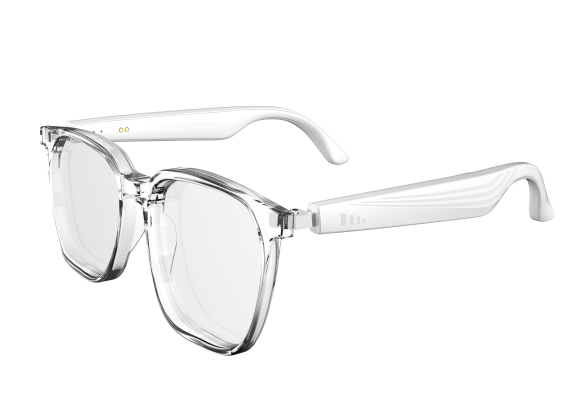
The Retail Advantage of Ultra-Low Latency Wearable Audio
Bluetooth 5.4 is not a generic marketing upgrade. It fundamentally changes how wireless glasses operate in high-interference environments like city streets, transit hubs, or crowded gyms.
Previous Bluetooth versions struggled to maintain dual-channel stability when separated by the human head—a natural barrier to radio frequencies. V5.4 introduces Periodic Advertising with Responses (PAwR) and improved encrypted connection subrating. For the end user, this means the left and right temple speakers stay perfectly synchronized without micro-stutters.
Lower latency also expands the product's viable use cases. Older smart glasses had noticeable audio lag, making them fine for music but terrible for watching video. V5.4 tightens that delay to a fraction of a millisecond. Now, a commuter watching a video on a train experiences perfect lip-sync.
There is a necessary trade-off to name here. Open-ear audio relies on directional micro-speakers firing downward toward the ear canal. Physics dictates that at maximum volume in a quiet room, nearby people will hear a faint bleed of sound. As a retailer, you must manage customer expectations. Position these as tools for situational awareness and background audio, not as noise-isolating audiophile monitors.
How Magnetic Charging and Dual 55mAh Batteries Resolve Consumer Pain Points
If you look at return logs for consumer electronics, physical charging ports are a primary point of failure. USB-C ports on eyeglass temples require thick plastic housings to accommodate the plug depth. Worse, an open port sitting right next to a wearer's hairline acts as a trap for sweat, rain, and skin oils, leading to rapid corrosion.
The G9 chassis replaces physical ports with magnetic pogo-pin charging interfaces. This allows the internal electronics to be completely sealed. The magnetic contacts sit flush against the frame, wiping clean easily and eliminating the risk of a snapped charging cable ruining the entire unit.
Battery placement is equally critical to the wearer's comfort. Instead of cramming a single large battery into one arm—which creates an unbalanced frame that constantly slides down the wearer's nose—the current standard splits the power. Utilizing dual 55mAh batteries places an identical cell in the left and right temples.
This split architecture centers the gravity over the ears, making lightweight bluetooth glasses in stock feel like standard optical frames. The downside? Magnetic charging requires a proprietary cable. If a consumer loses it, they cannot simply borrow a standard phone charger. Smart retailers mitigate this by stocking spare charging cables as high-margin add-on accessories.
Configuring Lens and Frame Options for US Retail Categories
Selling audio eyewear requires treating the product as apparel first and electronics second. A single SKU will not cover a diverse retail demographic. You need to configure the frames based on where the customer intends to wear them.
Transparent Lenses for Indoor and Office Environments
The fastest-growing segment for audio eyewear is the corporate and work-from-home market. Employees want to listen to podcasts or take Zoom calls without wearing heavy over-ear headphones that signal they are ignoring their colleagues.
For this demographic, specify transparent, anti-blue-light lenses. These lenses reduce eye strain from monitors while providing the audio utility. Crucially, the frames must be designed to accept prescription lenses later. Buyers will often take the frames to an optometrist to swap the stock transparent lenses for their own prescription, meaning the frame's lens groove must adhere to standard optical industry tolerances.
Tinted and Polarized Options for Outdoor Recreation
Outdoor buyers require UV400 protection and glare reduction. Polarized lenses are mandatory for driving, cycling, and running.
When selling into the outdoor recreation market, the physical grip of the frame matters as much as the lens. The injection-molded plastics must withstand temperature swings without becoming brittle. Because users will be sweating, the sealed magnetic charge audio sunglasses design becomes a primary selling feature rather than just a convenience.
Maintaining Inventory Stability With a 3,000-Unit Daily Production Capacity
A viral retail hit is worthless if you cannot replenish stock before consumer interest fades. Supply chain reliability is the actual product you are buying from a factory.
Cheung Shing operates a 40,000-square-meter facility in Huizhou, Guangdong, specifically engineered to prevent these bottlenecks. Many audio glasses suppliers are merely assemblers; they buy generic frames from one factory, PCB boards from another, and screw them together. If the frame supplier experiences a delay, the assembler's production halts.
Cheung Shing relies on in-house plastic injection molding. With over 100 injection machines on the floor, the company molds the structural components of the glasses directly. This vertical integration allows tight control over the exact tolerances required to seal the electronics against water and dust. It also guarantees consistent output. The facility maintains a production capacity of 3,000 units per day for specific electronics like the G9. When your US retail channels demand a sudden restock for Q4, the manufacturing infrastructure is already in place to deliver.
Managing OEM Customization and Freight Logistics From Huizhou
Off-the-shelf products are fine for market testing, but long-term retail margins require building your own brand equity. Transitioning from a buyer to an OEM smart glasses manufacturer partnership allows you to tailor the hardware to your specific audience.
Private Labeling and Touch Control Programming
The G9 model utilizes capacitive touch controls built into the temple arms. During the OEM process, these touch zones can be programmed to match consumer expectations. For example, you can specify that a double-tap answers a phone call, while a long press activates the smartphone's voice assistant.
A common field error in early touch-control glasses was over-sensitivity; users would accidentally hang up calls just by adjusting the glasses on their face. Precision tuning of the capacitive sensors prevents these false touches. Beyond firmware, private labeling allows pad printing of your brand logo on the inner temple and custom-molded retail packaging that aligns with your store's aesthetic.
US Import Compliance and Shipping Consolidation
Importing wireless electronics containing lithium batteries into the United States triggers strict regulatory requirements. The devices must carry FCC certification to prove they do not cause harmful radio interference, while the dual 55mAh batteries require UN38.3 testing documentation to clear air or ocean freight legally.
Working with an established factory in Huizhou simplifies this compliance, as the necessary certifications for the G9 architecture are already established. Geographically, Huizhou sits adjacent to Shenzhen and major export hubs like Yantian port. This proximity drastically reduces domestic transit times within China, making it simple for trading companies to consolidate the 2026 latest smart audio glasses with other consumer electronics shipments before they cross the Pacific.
If you are preparing a retail rollout, do not overcommit to a single lens style. Recommend your buyers start with a split order: blue-light transparent SKUs for the productivity market, alongside polarized models for outdoor recreation. Secure your inventory allocation for the upcoming season by reviewing the exact specifications of the G9 platform today.
Send Inquiry



X
We use cookies to offer you a better browsing experience, analyze site traffic and personalize content. By using this site, you agree to our use of cookies.
Privacy Policy